



What Really Moves a Stock? Reading Catalysts, Risks, and the Numbers Behind the Price
Growing revenue. Expanding margins. Billions spent on buybacks. Each can strengthen an investment story. But none tells you, on its own, whether a stock offers an attractive opportunity.
Before an earnings announcement, investors tend to focus on one question: will the company beat expectations?
The more useful question is what those results will change.
Will stronger sales translate into more cash? Can exceptional margins last? Are buybacks increasing each shareholder’s claim on the business? And how much improvement does the current price already assume?
NVIDIA brings these questions into focus. Its investment story requires investors to connect growth, profitability, capital allocation, and expectations rather than rely on a single headline.
Episode 12 of The Wealth Journey explores those connections: the financial catalysts that can create value, the risks that can erode it, and the developments that should make investors reconsider their original thesis.
1. A Catalyst Matters When It Changes the Outlook
An earnings announcement is an event. What the company reveals can become a catalyst.
A company may announce record revenue while revealing weaker profitability. It may beat earnings estimates because of a temporary benefit. Or it may report an ordinary quarter while providing evidence of a more durable improvement.
The investment significance depends on what changes in the expected future cash flows, financial risk, or valuation of the business.
When evaluating a headline, ask:
- What changed in the underlying business?
- Is the change likely to persist?
- How much of it was already reflected in the share price?
A positive development can be important without being surprising. A disappointing result can matter less if investors already expected something worse.
Stock prices respond to changes in the outlook relative to expectations, alongside broader market forces. Understanding the business is only part of the analysis; understanding what investors already anticipate is equally necessary.
2. Margins Explain What Revenue Growth Leaves Behind
Revenue shows how much a company sells. Operating margin shows how much remains after operating expenses, before interest and taxes.
Consider a business generating $10 billion in annual revenue.
At a 15% operating margin, it produces $1.5 billion in operating income. At a 20% margin, it produces $2 billion.
Revenue has not changed, but operating income has increased by roughly 33%.
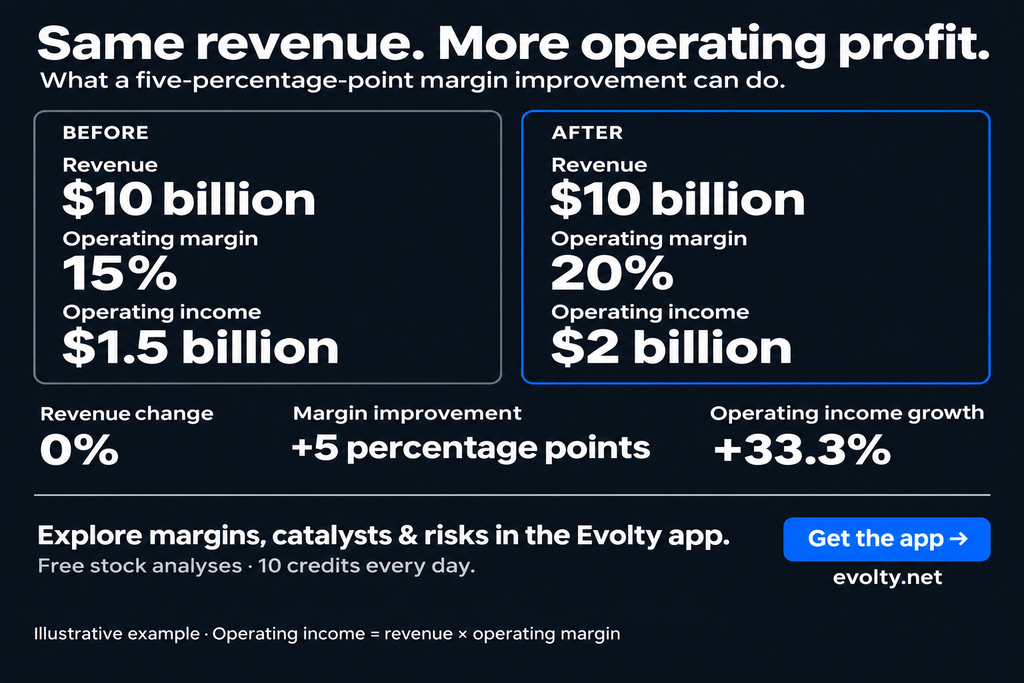
Illustrative example: a five-percentage-point increase in operating margin lifts operating income by 33.3%, with revenue unchanged.
Explore stock analyses for free in the Evolty app, with 10 credits every day. Download at evolty.net.
That five-percentage-point improvement could reflect pricing power, a more profitable product mix, better capacity utilization, or greater operating efficiency.
The next question is whether the improvement can last.
In the NVIDIA report reviewed for this article, Evolty identifies margin expansion as a catalyst. The useful follow-up is to examine what supports that expansion and what could reverse it.
For a semiconductor business, that investigation can include product mix, pricing, supply costs, competition, and the expense of introducing new products.
A strong margin describes performance over a particular period. An investment thesis needs a view on its durability.
3. Reported Earnings Need a Cash Flow Check
A company can report substantial profit without generating an equivalent amount of operating cash during the same period.
That difference deserves investigation.
Customers may be taking longer to pay. Inventory may be increasing ahead of deliveries. Investment gains may lift net income without producing operating cash. Timing differences can also create a temporary gap.
These explanations have different implications.
A cash conversion warning is a research question, not proof of an accounting problem.
This is where the NVIDIA analysis adds a useful counterweight to its favorable margin signal. Evolty also flags cash conversion and notes that certain earnings adjustments remain unreconciled.
Read together, those observations point to a question worth investigating:
How much of the reported improvement comes from recurring operations, and how much is supported by cash generation?
Answering it requires reviewing the cash flow statement and the notes behind the earnings figure.
Evolty’s Catalysts & Risks view helps you examine the evidence on both sides of an investment thesis. In the NVIDIA report below, margin expansion and continuing share repurchases appear alongside a cash conversion warning. Seeing them together helps frame the next research question: are stronger reported profits translating into sustainable cash generation?
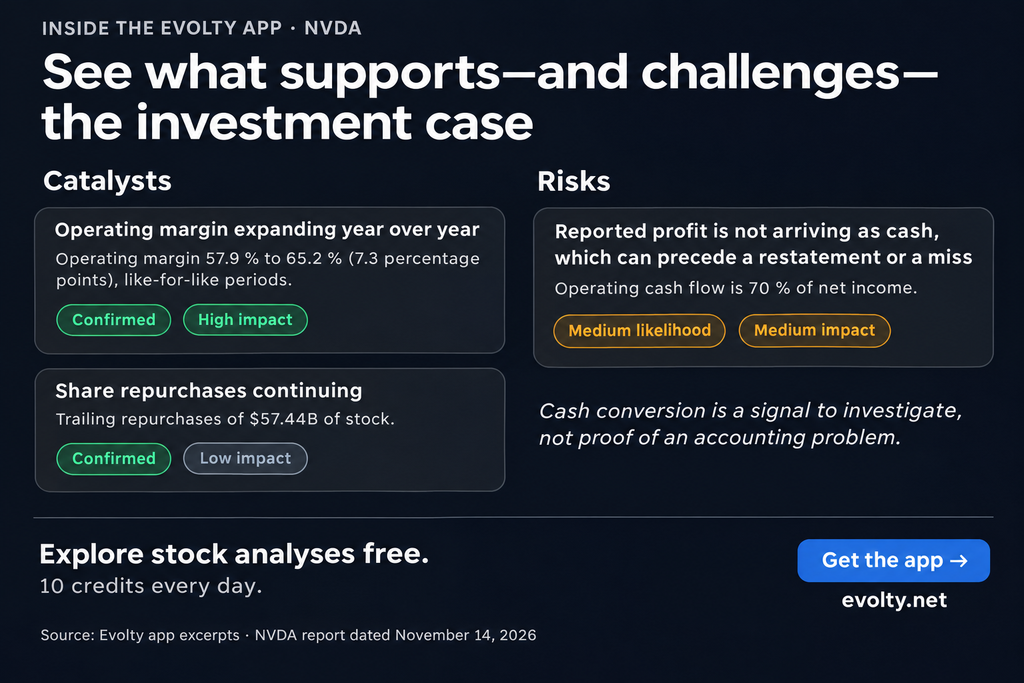
Selected views from Evolty’s NVIDIA analysis, dated November 14, 2026.
Strong profitability and a reason for further investigation can coexist.
4. Buybacks Matter Through Their Effect on Each Share
Share repurchases can increase the ownership percentage represented by each remaining share.
Suppose a company earns $1 billion and has 100 million shares outstanding. Earnings per share are $10.
If the share count falls to 90 million while earnings remain unchanged, earnings per share rise to approximately $11.11.
But the amount spent on repurchases does not establish how much value shareholders gained.
Investors also need to examine:
- Whether the company paid a reasonable price.
- Whether new share issuance offset the repurchases.
- Whether the spending weakened financial flexibility.
Evolty’s NVIDIA report identifies continuing repurchases alongside margin expansion. Those signals address different parts of the investment story: one concerns business profitability; the other concerns capital allocation and ownership per share.
The relevant measures include the change in the net share count, the purchase price, and the cash committed.
An authorization to buy back shares is also different from completed purchases. Investors should distinguish management’s announced intentions from what the company actually executes.
5. Debt Changes How Much Room a Business Has to Respond
Debt can help finance productive investment. It also creates obligations that remain when business conditions weaken.
The same debt balance can carry very different risks depending on interest costs, repayment dates, available cash, and the stability of operating cash flow.
Paying down debt may reduce interest expense and refinancing risk. However, reducing debt is not automatically the best use of every dollar. A company might have opportunities to invest at attractive returns while retaining manageable financing.
The analysis should connect the balance sheet to the business.
Can the company meet its obligations if growth slows? Does it have enough liquidity to fund operations and investment? Could refinancing become expensive at an inconvenient moment?
Debt ratios help organize those questions. Their interpretation depends on the industry, financing structure, and company circumstances.
EBITDA can provide one reference point, but it is not cash flow. Assessing financial flexibility also requires considering working capital, capital expenditure, interest payments, and debt maturities.
6. Scenarios Reveal What an Investment Thesis Requires
A valuation becomes more informative when its assumptions are visible.
Instead of focusing only on a projected share value, examine the growth, margins, cash flows, and valuation multiple required to produce it.
The NVIDIA report’s scenario section makes that sensitivity explicit: different combinations of growth, profitability, and exit multiples produce different modeled outcomes.
The practical question becomes:
What would the business need to deliver for this outcome to be reasonable?
A scenario that assumes unusually strong margins for many years requires different evidence from one that allows profitability to normalize.
Growth and margins also interact. A company can expand sales while retaining less profit from each dollar, changing the value created by that growth.
A favorable valuation depends on the reliability of the inputs. An attractive model output does not resolve uncertainty in the underlying earnings or cash flow data.
Scenario analysis helps make those dependencies visible. It does not remove them, and modeled outcomes should not be treated as promised returns.
7. Know What Would Change Your Mind
An investment thesis should include conditions that would require reassessment.
These might include sustained margin deterioration, weakening cash generation, rising refinancing risk, or dilution that prevents business growth from translating into growth per share.
Evolty’s NVIDIA report includes a section called “What would break the thesis.” It identifies conditions involving growth, profitability, leverage, cash flow, and share issuance that would prompt a fresh review.
This turns a broad investment narrative into specific signals to monitor.
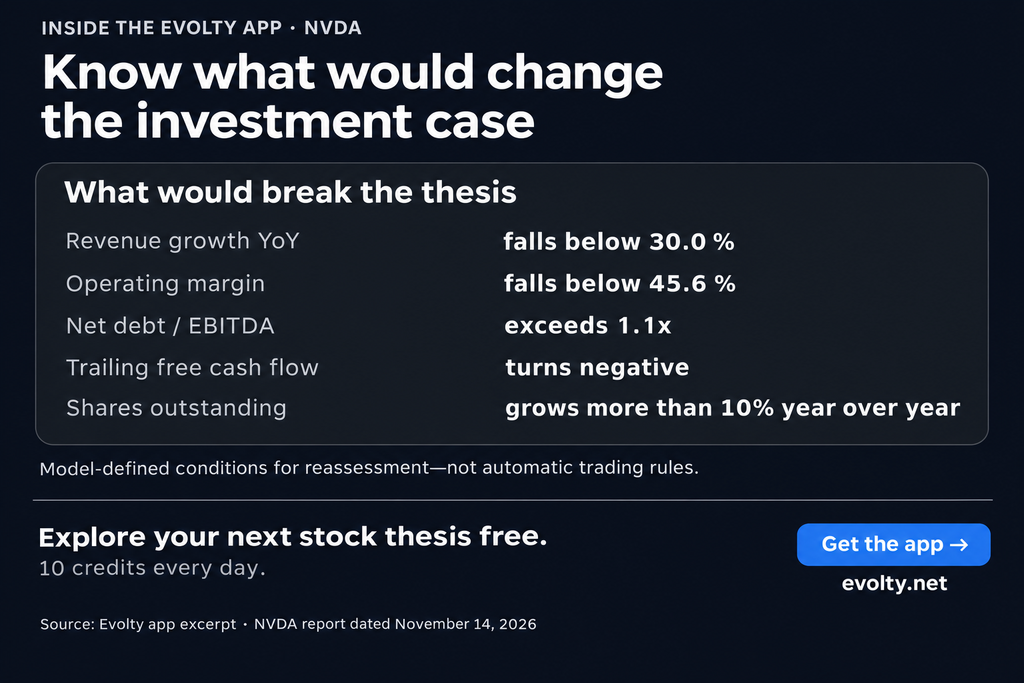
Evolty’s NVIDIA analysis identifies specific conditions that would prompt a reassessment of the investment thesis.
The thresholds in a model are starting points for investigation. Crossing one should prompt a review of the cause, duration, and financial consequences.
A temporary product transition and a lasting loss of competitive strength can produce similar short-term numbers. They deserve different interpretations.
Before the next earnings release, investors should be able to explain what would strengthen their thesis, what would weaken it, and which uncertainties remain unresolved.
That discipline makes it easier to assess new information without rewriting the investment story around every price movement.
8. When Does a Cheap Stock Become a Value Trap?
A low valuation multiple can reflect an overlooked opportunity. It can also reflect a business whose earnings are deteriorating.
The difference depends on what happens next.
If revenue weakens, margins contract, and cash generation declines, a seemingly low price-to-earnings ratio may be based on profits the business cannot sustain.
Conversely, a company trading at a higher multiple may justify part of that premium through more durable earnings and stronger cash generation.
Comparisons also require care. Companies in the same industry can have different business models, growth rates, accounting effects, and capital requirements.
This is why valuation, quality, and expectations belong in the same analysis.
For NVIDIA—or any other stock—the task is to examine whether the future economics support the price while identifying the evidence that could change that assessment.
A lower share price alone does not answer that question.
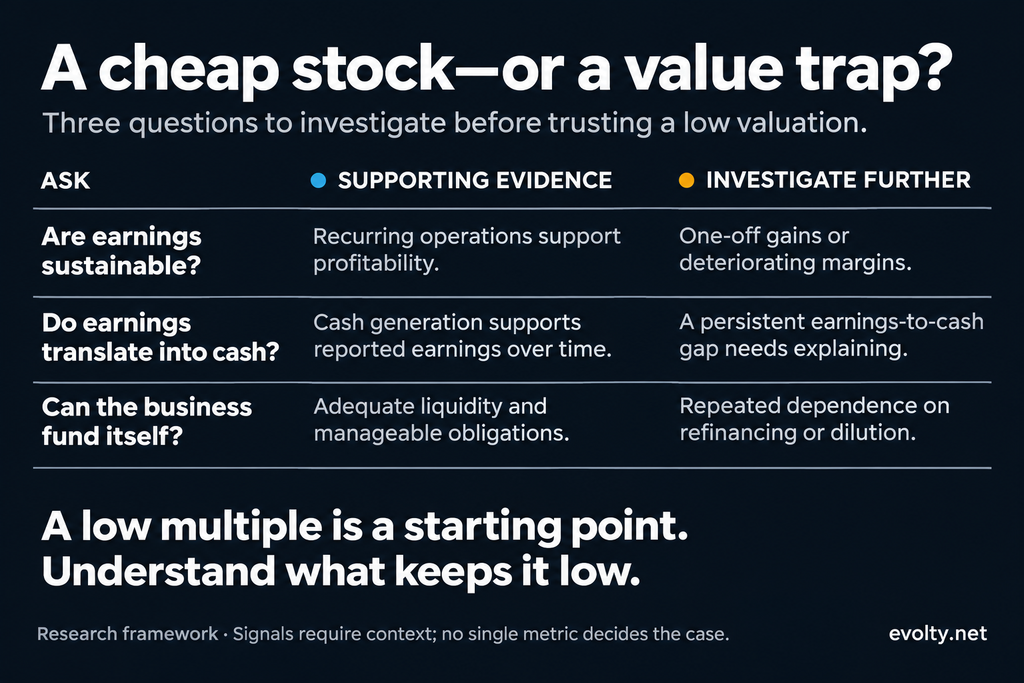
Read the Signals Together
Margin expansion matters more when it produces cash. Buybacks matter more when they reduce the net share count at sensible prices. Financial flexibility matters more when the business faces uncertainty.
The useful insight often comes from the relationship between the signals.
NVIDIA’s report illustrates this approach: favorable operating observations can sit alongside questions about earnings quality and assumptions that need further examination.
The aim is to understand what supports the investment case, what could undermine it, and what the current price requires the business to deliver.
Take your research further
Go deeper with Evolty.
A stock’s story goes beyond its headline price. Explore what drives a company’s performance, what the market expects, and what risks could change the picture.
Explore valuation, financial performance and growth expectations.
Compare peers, competitive advantages, risks and potential catalysts.
Bring multiple perspectives together before making your own investment decisions.
Start exploring stock research with Evolty.
🎧 Listen to Episode 12 of The Wealth Journey
For the full discussion, listen to “What Really Moves a Stock? Catalysts, Risks, and Value Traps” on Spotify.
Explore more episodes, research papers, and investing resources at evolty.net/resources.