



The Professional Stock Research Operating System | Evolty
Most investors don’t struggle to find stock ideas. They struggle to determine which ideas deserve their money.
A trending company, an exciting headline, or a stock that suddenly starts climbing can create a powerful sense of urgency. But a compelling story doesn’t necessarily translate into a sound investment. And a great business isn’t automatically a great stock to buy at any price.
The difference between speculation and disciplined investing often comes down to the process behind the decision.
In this guide, we explore how to build a professional stock research operating system: a repeatable framework for identifying opportunities, understanding businesses, analyzing financial performance, assessing competitive advantages, evaluating valuation, and managing risk.
The objective isn’t to predict every market move correctly. It’s to make thoughtful, evidence-based decisions consistently, while protecting yourself from emotional reactions and avoidable mistakes.
🎧 Listen to the full episode of The Wealth Journey on Spotify: The Professional Stock Research Operating System
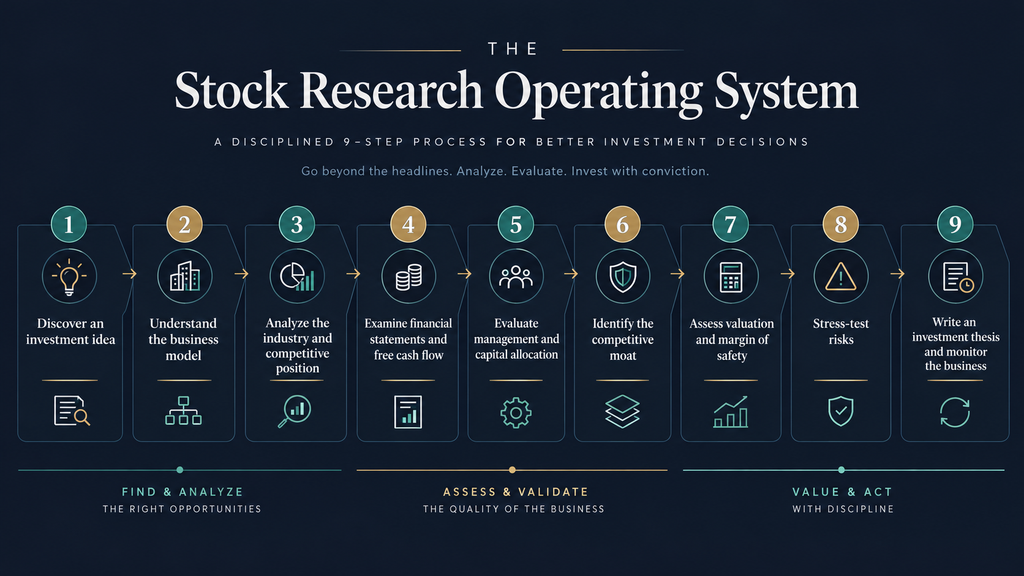
1. Start With a Process, Not a Stock Price
Social media, financial headlines, and market commentary make it easy to discover stocks. They also make it easy to confuse popularity with investment quality.
When an investor sees a company attracting attention, the temptation is to act before the opportunity disappears. This is where fear of missing out (FOMO) can replace careful analysis.
A disciplined research process changes the starting point. Instead of asking whether a stock is rising or whether everyone is talking about it, you ask whether the underlying business deserves further investigation.
A repeatable process creates consistency when market sentiment becomes unpredictable.
That doesn’t guarantee positive returns. Even carefully researched investments can lose money. But a structured approach helps you identify assumptions, evaluate evidence, and understand the risks you’re accepting.
The goal is to make decisions based on a consistent set of criteria rather than allowing each new headline to dictate your next move.
2. Find Investment Ideas in the World Around You
You don’t need an exclusive Wall Street connection to identify a company worth researching. Many investment ideas begin with ordinary observations.
Consider the products, services, and technologies you encounter in everyday life.
- What software are businesses increasingly adopting?
- Which brands have earned strong customer loyalty?
- What products are consistently in demand?
- Which industries are being reshaped by technology, demographics, or infrastructure investment?
These observations can help you identify businesses benefiting from changing consumer behavior or long-term economic trends.
You can then combine those observations with broader industry research, company disclosures, and financial publications.
However, an interesting trend is only a starting point. A popular product doesn’t automatically imply an attractive stock, and growing demand doesn’t guarantee that a company will capture the resulting profits.
An idea isn’t an investment. It’s an invitation to investigate.
At this stage, your objective is to create a watchlist of companies that deserve deeper analysis, not to rush into a purchase.
3. Understand the Business Before Analyzing the Stock
Before examining a stock chart or valuation multiple, establish how the business actually works.
Start with three fundamental questions:
- How does the company make money?
- Who are its customers, and why do they pay for its products or services?
- What problem does the business solve, and why is its solution competitive?
The answers should help you understand the company’s revenue model, customer base, cost structure, and position in the market.
For example, two software companies may both report rapid revenue growth. One might generate recurring subscription revenue from long-term enterprise customers. The other might depend on one-time contracts, heavy customer acquisition spending, and continuous new sales to maintain growth.
The headline numbers may look similar, but the underlying economics can be very different.
This is where the concept of a circle of competence becomes useful. Investors should recognize the limits of what they understand and avoid treating complexity as evidence of opportunity.
You don’t need to understand every technical detail of every business. You do need enough understanding to explain its economic model, identify its major risks, and evaluate the reasons customers choose it over alternatives.
If you cannot explain how the business creates value, you have little foundation for judging whether its stock is attractive.
4. Evaluate the Industry and Competitive Landscape
A business doesn’t operate in isolation. Its prospects depend partly on the industry in which it competes.
Before evaluating an individual company, examine the market around it.
Is the industry growing or contracting?
Long-term trends such as digital transformation, infrastructure investment, demographic changes, and AI adoption can create opportunities for certain industries.
But growth alone isn’t enough. An expanding market can still produce disappointing investment returns if competition drives prices down or companies spend too much to acquire customers.
Conversely, a company in a mature industry may remain attractive if it has strong economics, disciplined management, and a defensible competitive position.
What determines profitability in this market?
Look at the forces that shape industry economics:
- The intensity of competition.
- The bargaining power of customers and suppliers.
- Barriers to entry for new competitors.
- The availability of substitutes.
- The potential for pricing power and sustainable margins.
These factors help explain whether an industry offers favorable conditions for long-term profitability.
Where does the company stand?
Once you understand the industry, assess the company’s position within it.
Is it a market leader with pricing power? Does it serve a specialized segment particularly well? Is it one of many businesses offering nearly interchangeable products?
Market share can provide useful context, but it doesn’t tell the entire story. A smaller company with strong customer retention and attractive unit economics may be better positioned than a larger competitor with weak profitability.
The key is to understand not just whether a market is growing, but whether the company can turn that opportunity into durable economic value.
5. Read the Financial Statements Together
Financial statements are most useful when analyzed as a connected picture of the business rather than as three separate reports.
The income statement, balance sheet, and cash flow statement each answer different questions. Looking at them together helps you identify strengths, weaknesses, and inconsistencies that a single metric might conceal.
The income statement: Is the business profitable?
Revenue growth can indicate increasing demand, while operating margins and net income help reveal whether the company converts sales into earnings.
But rising revenue or earnings alone doesn’t establish financial strength.
A company may report growing profits while struggling to collect payments, funding expansion inefficiently, or accumulating obligations that weaken its financial position.
You need to understand what is driving the reported results and whether those results are sustainable.
The balance sheet: Can the business withstand pressure?
The balance sheet provides a snapshot of a company’s assets, liabilities, and equity.
Examine its cash position, debt obligations, working capital, and other financial commitments.
Consider what might happen if sales slow, borrowing costs rise, or customers delay payments. Would the company have sufficient financial flexibility to manage the disruption?
The answer depends on the business model and industry, but the underlying objective is the same: assess financial resilience rather than focusing only on recent growth.
The cash flow statement: Are earnings translating into cash?
Accrual accounting allows companies to recognize revenue and expenses according to accounting rules rather than simply when cash changes hands.
Consequently, reported earnings and actual cash generation can differ substantially.
A company might report a profit while cash remains tied up in unpaid invoices or other working-capital requirements. If that situation persists, it can create operational pressure even when the income statement looks healthy.
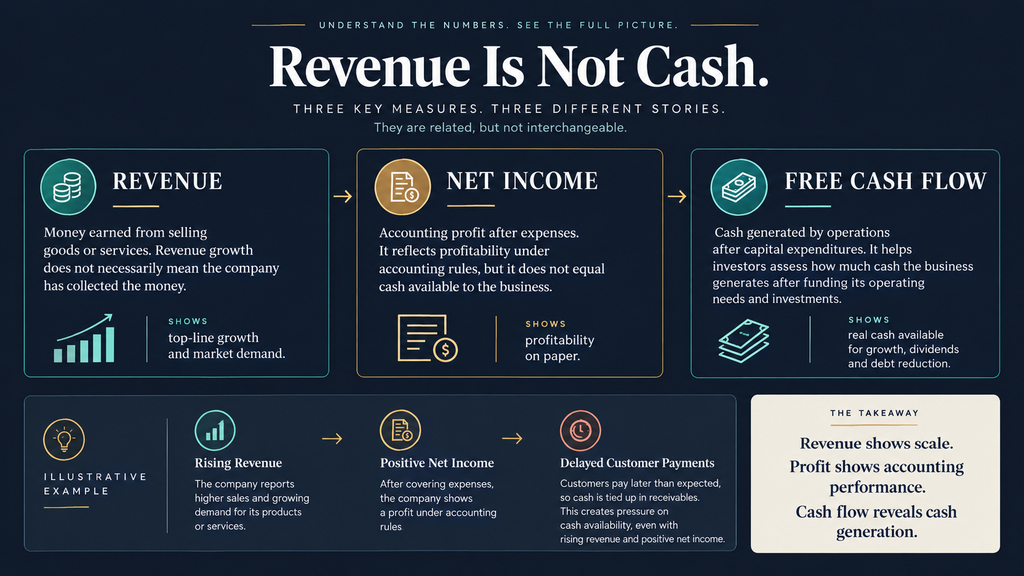
This makes cash flow analysis essential.
Revenue is vanity. Profit is sanity. Cash is reality.
The phrase is memorable, but the analytical lesson is more important: revenue and earnings must be evaluated alongside the cash the business actually generates.
Why free cash flow matters
Free cash flow (FCF) generally refers to operating cash flow minus capital expenditures, although analytical definitions can vary.
It helps investors assess how much cash remains after the business funds its operating activities and capital investments.
A company that generates sustainable free cash flow may have greater flexibility to invest in growth, reduce debt, acquire businesses, or return capital to shareholders.
By contrast, persistent negative free cash flow deserves investigation. It might reflect a business model under pressure, but it could also result from deliberate investment in expansion or temporary working-capital changes.
The context matters.
The goal isn’t to label every negative cash flow figure as a warning sign. It’s to understand why cash generation is changing and whether the company’s financial trajectory supports its investment case.
6. Examine Management and Capital Allocation
A profitable business can still destroy shareholder value through poor decisions.
Management determines how a company deploys the resources it generates. This is known as capital allocation, and it can have a substantial impact on long-term investment returns.
Executives typically face choices such as:
- Reinvesting in research, product development, and expansion.
- Acquiring other companies.
- Paying down debt.
- Returning capital to shareholders through dividends or share repurchases.
None of these decisions is automatically good or bad. Their value depends on the price paid, the expected return, the company’s financial position, and the alternatives available.
An acquisition, for example, might expand a company’s capabilities or open an attractive new market. But buying another business at an excessive premium can destroy value even when the acquired company increases total revenue.
Likewise, share repurchases can benefit shareholders when executed at attractive valuations, but they can be wasteful when a company pays too much for its own shares or neglects better uses of capital.
Look beyond management’s promises
Annual reports and earnings discussions can help investors understand how executives explain performance, allocate resources, and respond to setbacks.
Pay attention to whether management acknowledges mistakes, explains disappointing results clearly, and connects its decisions to measurable outcomes.
Transparency is useful, but communication alone isn’t proof of competence. Management’s explanations should be tested against the financial results and subsequent decisions.
The central question is whether leadership consistently allocates capital in ways that strengthen the business and create long-term shareholder value.
7. Identify the Company’s Competitive Advantage
A competitive advantage helps explain why a company can sustain attractive economics when competitors are trying to win the same customers.
Investors often describe a durable advantage as an economic moat: a structural feature that makes it difficult for competitors to erode a company’s position.
Several sources of competitive advantage deserve attention.
Brand strength
A trusted brand can influence customer preference, support pricing power, and reduce the need to compete exclusively on price.
However, brand recognition matters most when it translates into measurable economic benefits, such as customer loyalty, stronger margins, or repeat purchases.
Network effects
Network effects occur when a product or service becomes more valuable to users as participation grows.
A marketplace, for example, may attract more buyers as its seller base expands. More buyers can then attract additional sellers, reinforcing the network.
The strength of this advantage depends on whether users genuinely benefit from the larger network and whether competitors can replicate it or persuade participants to switch.
Cost advantages
Some businesses can deliver products or services at a lower cost because of their scale, purchasing power, operational efficiency, or distribution networks.
A durable cost advantage can support competitive pricing or stronger margins.
The important question is whether competitors can realistically reproduce the advantage.
Intellectual property
Patents, proprietary technology, and specialized expertise may protect a company’s products from direct imitation.
But investors should also consider patent expiration, technological change, legal challenges, and the possibility that a competitor will develop a different solution.
Switching costs
Switching costs arise when customers face significant financial, operational, or practical obstacles to moving to another provider.
Enterprise software offers a useful example. A system integrated deeply into a company’s workflows may be expensive and disruptive to replace.
That can support customer retention and recurring revenue, provided the solution continues to deliver value.
A moat must be durable
A competitive advantage is not permanent simply because a company has enjoyed success in the past.
Technology changes, customer preferences evolve, regulation shifts, and new competitors emerge. Investors should examine both the source of an advantage and the evidence that it can endure.
The strongest investment cases connect competitive advantages to observable business outcomes, such as customer retention, pricing power, resilient margins, and sustainable cash generation.
8. Remember: A Great Company Is Not Always a Great Investment
Even after identifying a strong business with a durable competitive advantage, one major question remains:
Is the stock worth its current price?
Company quality and investment attractiveness are related, but they are not the same thing.
A business can perform exceptionally well while its stock delivers disappointing returns if investors paid a price that already anticipated years of extraordinary growth.
This is why valuation must be part of the research process.
Price-to-earnings ratio (P/E)
The P/E ratio compares a company’s share price with its earnings per share.
A high P/E ratio can reflect expectations of strong future growth, confidence in the business, or other factors. It can also mean investors are paying a premium that leaves little room for disappointment.
A low P/E ratio isn’t automatically attractive either. The market may be anticipating declining earnings, structural challenges, or other risks.
Compare valuation with the company’s growth prospects, profitability, risk profile, industry, and historical range. No single multiple tells the whole story.
Return on equity (ROE)
Return on equity measures net income relative to shareholders’ equity.
It can help assess how effectively a company generates accounting profits from its equity base. However, high ROE can also be influenced by leverage, share repurchases, or a small equity base.
Interpret it alongside debt levels, cash flow, and the company’s broader financial structure.
Free cash flow yield
Free cash flow yield compares free cash flow with the company’s market value, commonly its market capitalization.
It offers another way to assess the cash generation investors are receiving relative to the price they pay.
A higher yield may indicate an attractive valuation, but only if the cash flow is sustainable. A temporarily inflated cash flow figure or a business facing structural decline can make a stock appear cheaper than it really is.
Look for a gap between price and value
The purpose of valuation isn’t to find the cheapest stock. It’s to determine whether the market price reasonably reflects the business’s underlying economics and future prospects.
This is where the concept of margin of safety becomes important.
A margin of safety means avoiding assumptions so optimistic that even a modest disappointment could undermine the investment case. It involves recognizing the uncertainty in financial forecasts and being cautious about what you’re willing to pay.
A disciplined investor evaluates the business, estimates its value using reasonable assumptions, and considers how much uncertainty the current price leaves room for.
9. Stress-Test the Investment Thesis Before You Buy
Investors naturally focus on what could go right. Strong research also examines what could go wrong.
Risk analysis means identifying the events or conditions that could materially damage the business, undermine its competitive position, or invalidate the investment thesis.
Start with company-specific risks:
- Is the company overly dependent on a small number of customers or suppliers?
- Could a leadership change disrupt its strategy?
- Is the business accumulating debt that may become difficult to service?
- Could a competitor erode its pricing power or customer relationships?
- Are its earnings dependent on assumptions that may not hold?
Then consider external risks, including inflation, interest rates, regulatory changes, supply-chain disruptions, and shifts in customer demand.
Not every risk will be predictable, and no checklist can eliminate uncertainty. The purpose is to identify vulnerabilities before committing capital and assess whether the potential return adequately compensates for them.
Focus on downside exposure, not just upside potential
A common mistake is to become absorbed in calculating how much a stock could rise while giving insufficient attention to how much capital could be lost.
Protecting against permanent capital impairment is central to disciplined investing. A severe loss can require a disproportionately large gain just to recover the original investment.
For example, a 50% decline requires a 100% gain on the remaining capital to return to the starting point.
This is one reason risk management deserves a central place in investment research.
It doesn’t mean avoiding every uncertain investment. It means understanding the downside, recognizing what could invalidate your assumptions, and deciding whether the risk is acceptable before investing.
10. Write a One-Page Investment Thesis
After analyzing the business, industry, financials, management, competitive advantages, valuation, and risks, bring the findings together in a written investment thesis.
Writing forces you to distinguish the essential evidence from the surrounding noise.
A practical one-page thesis should address:
Business model: How does the company generate revenue and profit?
Industry and competitive position: What drives demand, and why might this company outperform competitors?
Financial strength: What do earnings, balance-sheet metrics, and free cash flow reveal about the business?
Management and capital allocation: How effectively does leadership deploy the company’s resources?
Competitive advantage: What protects the business from competitors, and how durable is that protection?
Growth drivers: What specific developments could improve the company’s future performance?
Valuation: What is a reasonable estimate of the company’s value, and what assumptions support it?
Risks and invalidation criteria: What could undermine the thesis, and what evidence would demonstrate that the original reasoning was wrong?
The final section is particularly important. A useful thesis should be testable against future evidence, not written to justify a decision you have already made.
If you cannot explain the investment case clearly and concisely, revisit the analysis before acting.
The objective is not to eliminate complexity from the business. It is to make your reasoning transparent enough that you can evaluate it objectively.
11. Monitor the Business Without Obsessing Over the Stock Price
Research doesn’t end when you buy a stock.
Businesses evolve. Competitors change their strategies, financial conditions shift, management makes new decisions, and the original investment assumptions may become less relevant.
Monitoring helps determine whether the business continues to support the investment thesis.
Quarterly earnings reports, annual filings, company announcements, and relevant industry developments can provide evidence about whether the business is progressing as expected.
But there is an important distinction between monitoring the business and reacting to every movement in its share price.
A stock can decline even when the underlying business remains healthy. It can also rise while the company’s fundamentals deteriorate.
Price movements deserve attention, but they need to be interpreted in context.
Watch for thesis drift
Thesis drift occurs when the actual business gradually diverges from the reasons you originally invested, without a corresponding reassessment of your assumptions.
Perhaps customer retention is weakening. Maybe the company is losing pricing power, taking on excessive debt, or allocating capital in ways that reduce its long-term prospects.
These developments matter because they may undermine the original investment case even if the stock price hasn’t fully reflected the damage.
A useful monitoring question is:
Based on the latest fundamental information and the current valuation, would I still consider this an attractive investment?
The answer may change as new evidence becomes available. A disciplined investor is willing to revisit assumptions, revise a thesis, or walk away when the facts no longer support the original decision.
Long-term investing doesn’t mean ignoring new information. It means distinguishing meaningful changes in business fundamentals from short-term market noise.
12. Put the Framework Into Practice
A research framework only becomes useful when you apply it consistently.
For your next research exercise, choose one publicly traded company and work through the process without starting with its stock chart.
Use this checklist to organize your analysis.
- Identify why the company deserves further research.
- Explain its business model and how it makes money.
- Assess industry trends and competitive positioning.
- Review the income statement, balance sheet, and cash flow statement together.
- Evaluate free cash flow and financial resilience.
- Examine management’s capital allocation decisions.
- Identify the company’s competitive advantages and their durability.
- Assess valuation using appropriate financial metrics and reasonable assumptions.
- Identify the major risks and what could invalidate your thesis.
- Write a concise, one-page investment thesis.
- Define what you will monitor to determine whether the thesis remains intact.
You don’t need to reach a buy decision at the end. Concluding that a company is too difficult to understand, too risky, or unattractively valued is a legitimate research outcome.
The purpose of the exercise is to develop a repeatable way to evaluate opportunities, not to force an investment decision.
The Next Competitive Advantage in Investing
As financial information, analytical tools, and research technology become more accessible, individual investors have greater opportunities to study businesses systematically.
But wider access to information raises an interesting question.
If more investors can access similar data and use similar analytical frameworks, what will distinguish the best investment decisions?
The answer may depend on the quality of the questions investors ask, the assumptions they challenge, the evidence they prioritize, and their willingness to change their minds.
A framework provides structure, but it doesn’t replace independent judgment. Financial metrics require context, forecasts remain uncertain, and even a carefully constructed thesis can be wrong.
The objective is not to follow a checklist mechanically. It’s to use a consistent process to develop a better understanding of the business and make decisions with greater clarity.
The research process is your defense against hype. Your judgment is what makes the process useful.
Key Takeaways
- Start with the business, not the ticker. A compelling stock story is only a starting point for research.
- Understand the industry. Market growth matters, but competitive dynamics determine how much value a company can capture.
- Connect the financial statements. Earnings, financial resilience, and cash generation tell different parts of the story.
- Evaluate management and the moat. Sustainable returns depend partly on how well a company allocates capital and defends its position.
- Separate business quality from stock valuation. Even an excellent company can be a poor investment at an excessive price.
- Stress-test your assumptions. Identify risks and define what would invalidate the investment thesis.
- Document your reasoning. A concise, testable thesis provides a baseline for future decisions.
- Monitor fundamentals, not every fluctuation. Reassess the business as new evidence emerges rather than reacting automatically to market sentiment.
Listen to The Wealth Journey
Want to explore the complete framework in a conversation?
🎧 Listen to The Professional Stock Research Operating System on Spotify.
The episode walks through the research process, from finding a promising business to evaluating its financial strength, competitive advantages, valuation, and risks.
Take your research further
Go deeper with Evolty.
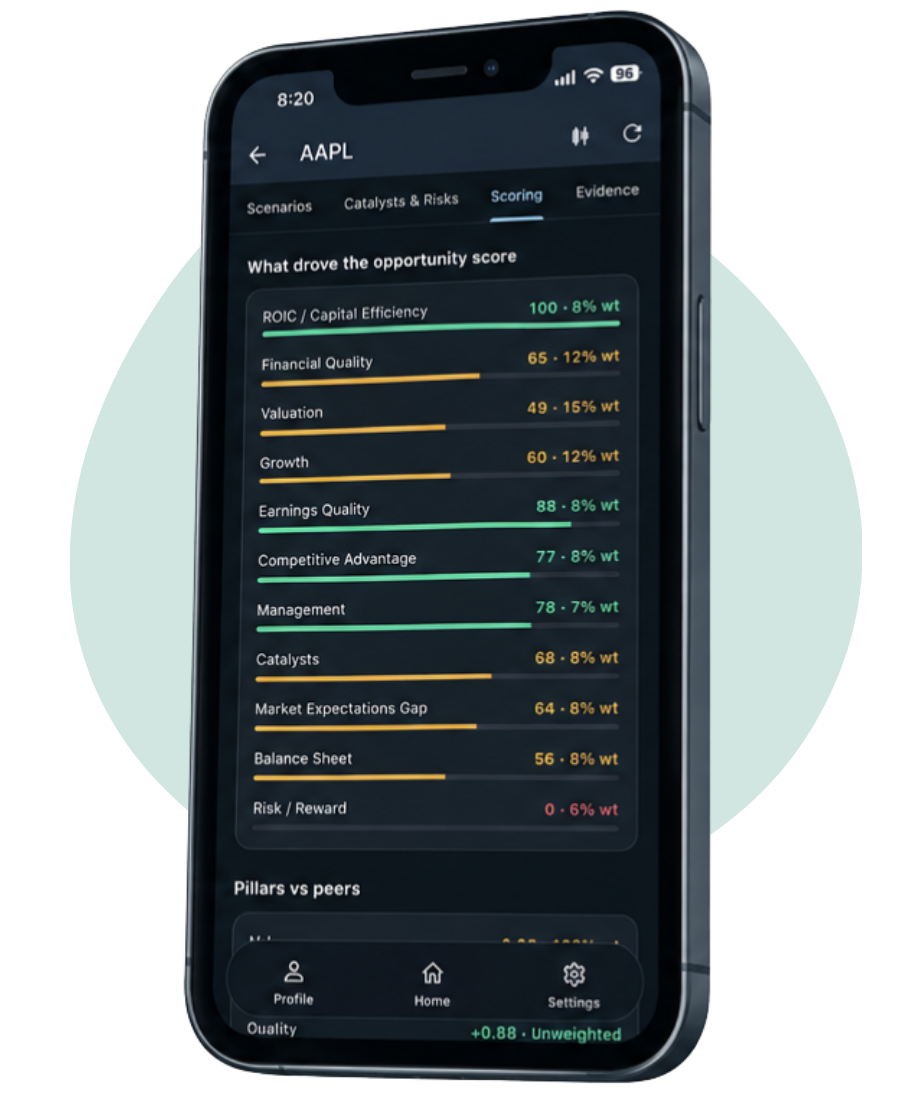
A stock’s story goes beyond its headline price. Explore what drives a company’s performance, what the market expects, and what risks could change the picture.
Explore valuation, financial performance and growth expectations.
Compare peers, competitive advantages, risks and potential catalysts.
Bring multiple perspectives together before making your own investment decisions.
Start exploring stock research with Evolty.
Explore Stock Research With Evolty
Good investing begins with understanding what you own.
Evolty is built around stock research and financial education, helping investors explore publicly traded companies and develop a more structured approach to understanding the market.
Important Disclosure
This article is for educational and informational purposes only. It does not constitute investment, financial, tax, or legal advice, nor is it a recommendation to buy, sell, or hold any security. All investments involve risk, including the possible loss of principal. Financial metrics and valuation methods have limitations and should be interpreted in context. Conduct your own research and consider consulting a qualified financial professional before making investment decisions.