


Why Record Profits Can Tank a Stock: Understanding Market Expectations
A company can report its best quarter ever and still lose billions in market value. The explanation often lies not in what the company achieved, but in what investors expected it to achieve.
Imagine a company announcing record revenue, expanding profit margins, and double-digit earnings growth.
By almost every traditional financial measure, the business appears to be performing exceptionally well.
Then the market opens.
Its stock drops 20%.
For many investors, the reaction seems irrational. How can a company deliver strong results and still see its valuation collapse?
The answer reveals one of the most important distinctions in equity investing: financial performance describes what a company has achieved, while stock prices reflect expectations about what comes next.
Understanding the difference can fundamentally change how investors evaluate opportunities, interpret earnings announcements, and assess whether a stock is attractively priced.
1. Why Good Earnings Don’t Always Mean Higher Stock Prices
One of the most common mistakes investors make is assuming that strong financial results should automatically translate into rising stock prices.
But the market is not simply measuring whether a company is performing well.
It is constantly reassessing whether the business is likely to perform better or worse than investors previously anticipated.
Consider two companies.
Company A reports 15% revenue growth. That’s impressive. However, analysts had expected 22% growth, and management lowers its guidance for the following quarter.
Company B reports a 3% revenue decline. Its business is struggling, but analysts had expected revenue to fall by 12%. Management also signals that conditions are stabilizing.
Which stock is more likely to react positively?
Surprisingly, it could be Company B.
Its financial performance is objectively weaker, but its results suggest that the future may be better than investors had feared.
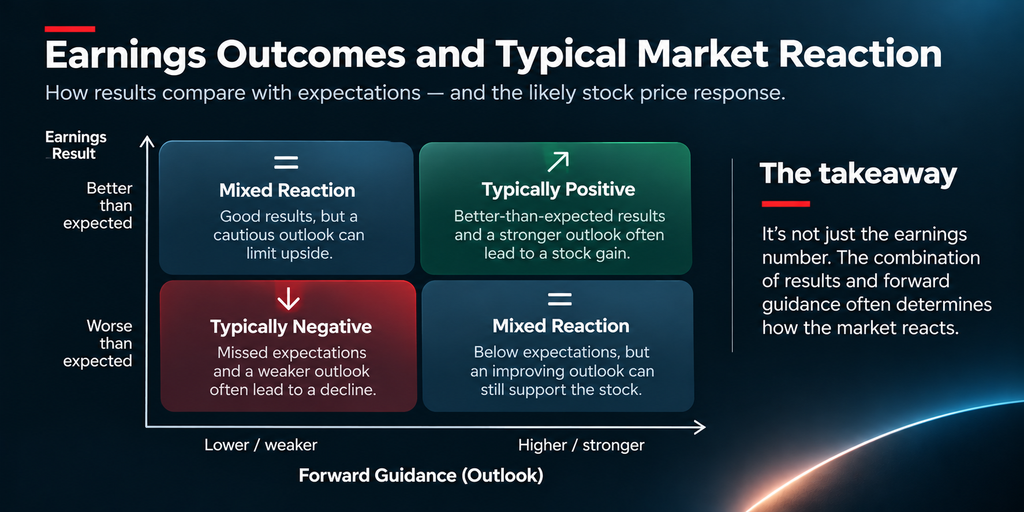
Company A faces the opposite problem: strong results that fall short of elevated expectations.
This is why a great business can deliver disappointing investment returns, while a struggling business can experience a powerful stock rally.
The difference often comes down to expectations and valuation.
2. The Expectation Gap: What the Market Already Priced In
Investors rarely evaluate earnings announcements in isolation.
Before a company reports results, analysts and market participants have already formed expectations about revenue, profitability, cash flow, and future growth.
Those expectations influence the stock’s current valuation.
When new information becomes available, investors reassess whether the assumptions supporting that valuation remain reasonable.
The difference between actual results and prior expectations is often called an expectation gap.
An example: Strong results, disappointing expectations
Imagine a company publishes the following quarterly performance:
| Financial metric | Actual result | Market expectation |
|---|---|---|
| Revenue growth | +9% | +12% |
| Operating margin | 18% | 22% |
| EPS growth | +10% | +18% |
| Free cash flow growth | +8% | +15% |
Illustrative example.
Every actual figure is positive.
Revenue increased. Profitability remained healthy. Earnings and cash flow both improved.
Yet every result fell short of what investors expected.
The company is still growing, but its financial trajectory may no longer justify the valuation investors were willing to pay.
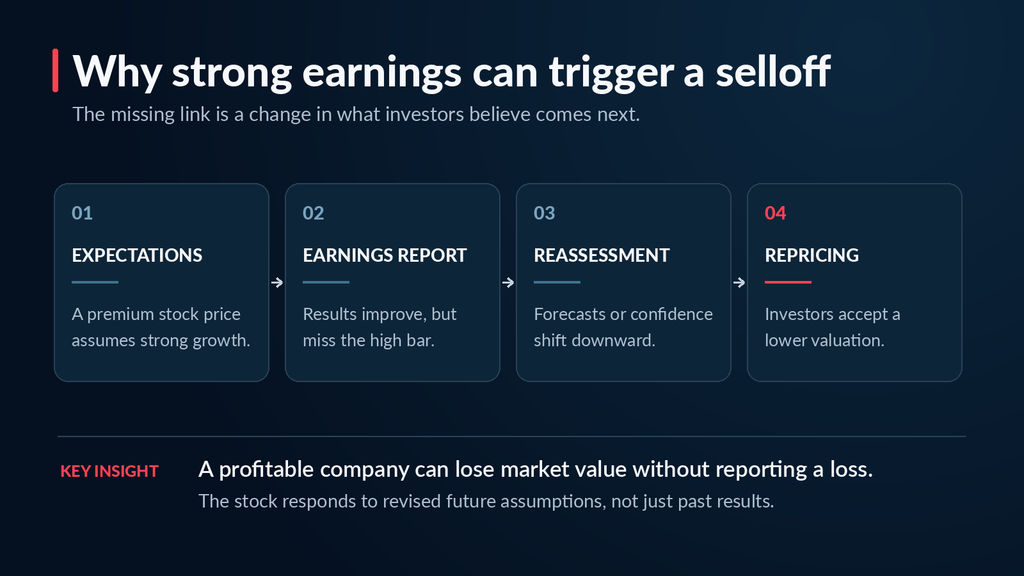
As expectations adjust, the stock price can fall sharply.
The important distinction is that investors are not necessarily reacting to poor performance.
They are reacting to a change in the company’s expected future performance.
3. Valuation Matters: Why the Price You Pay Changes Everything
Strong businesses are not automatically attractive investments at every price.
A company with exceptional profitability, durable competitive advantages, and consistent growth can still be overvalued if its share price assumes an unrealistic future.
This is where valuation analysis becomes essential.
Professional investors use several frameworks to estimate what a business may be worth and determine whether its current market price is justified.
Discounted Cash Flow: Valuing Future Cash Generation
Discounted Cash Flow (DCF) analysis estimates the present value of the cash a company is expected to generate in the future.
Instead of focusing exclusively on historical earnings, a DCF model asks investors to consider several assumptions:
- How quickly will revenue grow?
- How profitable will the company become?
- How much free cash flow will the business generate?
- What return should investors require for the risks involved?
- How much value will the business generate beyond the explicit forecast period?
The resulting valuation can be useful, but it is highly sensitive to assumptions.
Why small changes can have a big impact
Imagine a valuation model producing an estimated intrinsic value of $150 per share.
If the required rate of return increases, the same projected cash flows become less valuable today.
A change in discount rate, long-term growth, or terminal value assumptions can materially reduce the model’s estimated valuation, even when the company’s current operations have not deteriorated.
This illustrates a fundamental limitation of valuation models:
An estimated intrinsic value is not a precise prediction of where a stock will trade.
It is the outcome of assumptions that should be tested.
Rather than depending on a single price target, investors can evaluate a range of possible outcomes under different growth, profitability, and risk assumptions.
A bull case, base case, and bear case help reveal how much uncertainty is embedded in a valuation.
4. Forward Multiples: What Investors Are Paying for Tomorrow
While DCF models provide a detailed valuation framework, investors also use financial multiples to evaluate companies more quickly.
Two widely used measures are forward price-to-earnings and enterprise value to EBITDA.
Forward P/E: The Price of Expected Earnings
The forward price-to-earnings ratio compares a company’s current share price with its expected earnings per share over a future period.
For example, a stock trading at 40 times forward earnings commands a much higher earnings multiple than one trading at 15 times.
But does that automatically make the first stock overvalued?
Not necessarily.
A higher multiple may reflect expectations of faster growth, stronger competitive advantages, or more predictable future earnings.
The problem arises when those expectations become difficult to achieve.
If investors are paying a premium for rapid growth and management subsequently signals a slowdown, the stock can experience multiple compression.
That means investors become willing to pay less for each dollar of expected earnings.
A company can therefore increase its earnings while its stock price declines because its valuation multiple falls by an even greater amount.
EV/EBITDA: Looking Beyond the Share Price
Another commonly used metric is enterprise value to EBITDA.
Enterprise value considers the value of a business’s equity alongside debt and cash, while EBITDA measures earnings before interest, taxes, depreciation, and amortization.
The ratio can help compare operating valuations across companies with different financing structures.
However, EBITDA is not the same as free cash flow. It does not fully account for capital expenditures, taxes, or working-capital requirements.
That distinction becomes especially important when comparing capital-intensive businesses with companies that require relatively little ongoing investment.
No single valuation multiple tells the whole story.
A meaningful assessment requires context: business quality, growth potential, industry economics, financial risks, and the assumptions already reflected in the price.
5. Profitability Is Important. Its Sustainability Matters More.
Operating margins reveal how efficiently a company converts revenue into operating profit.
A business with a 25% operating margin generates $25 in operating income for every $100 of revenue.
That can indicate strong pricing power, operational discipline, or structural competitive advantages.
But investors should look beyond a single quarter.
Suppose a company significantly improves its margins by reducing research and development spending or cutting customer acquisition investments.
Short-term profitability may improve.
Yet those decisions could weaken innovation, competitive positioning, or future growth.
The same financial result can therefore have very different implications depending on how it was achieved.
Investors should examine whether margin expansion comes from durable operating improvements or decisions that may compromise future performance.
Free cash flow is another important part of this assessment.
Accounting earnings and cash generation do not always move together. Differences may arise from capital expenditures, working capital, revenue recognition, or other factors.
Understanding those differences helps investors assess the quality and sustainability of reported results.
6. Three Questions to Ask Before Reacting to an Earnings Report
An earnings announcement can produce an immediate emotional reaction, particularly when a stock moves sharply.
Instead of focusing exclusively on the headline, investors can use three questions to evaluate what actually changed.
1. Did the company beat or miss expectations?
Compare actual revenue, earnings, margins, and cash flow with prior analyst estimates.
Strong year-over-year growth does not necessarily mean the results exceeded expectations.
2. What changed about the future?
Management guidance can be more important than the quarter just reported.
Look for changes in expected revenue growth, profitability, capital expenditures, competitive conditions, and demand.
A strong quarter accompanied by weaker guidance may lead investors to revise their long-term assumptions.
3. Does the valuation still make sense?
A business may be performing well while its share price reflects unusually optimistic assumptions.
Compare its valuation with companies that have similar growth profiles, business models, profitability, and risk characteristics.
Also consider what would happen if growth slows or margins fail to reach projected levels.
The goal is not simply to identify strong companies. It is to understand what their current prices require them to deliver.
7. When Expectations Become More Important Than Headlines
Financial markets constantly incorporate new information.
A disappointing earnings release can trigger a rally if investors conclude that future conditions are improving.
An impressive earnings announcement can lead to a selloff if the outlook becomes less favorable than previously assumed.
Interest rates, economic conditions, industry developments, and investor risk appetite can further influence how those expectations translate into valuations.
This does not mean fundamentals are irrelevant.
Over longer periods, a company’s ability to generate sustainable cash flows remains central to its economic value.
But understanding fundamentals is only part of investing.
Investors must also consider the expectations embedded in a stock’s price and how those expectations might change.
That is often where the difference between a successful company and a successful investment becomes clear.
Final Thoughts: A Great Company Is Not Always a Great Investment at Any Price
Record profits can signal a healthy business.
They do not guarantee positive stock returns.
The market’s reaction depends on far more than the reported earnings figure. Future growth expectations, valuation assumptions, operating performance, and the broader economic environment all influence how investors price a company.
The most useful question is not simply whether a business is performing well.
It is whether the company’s likely future performance supports the expectations already reflected in its stock price.
For investors willing to look beyond quarterly headlines, that distinction provides a more informed way to evaluate opportunities and risks.
🎧 Explore the Full Discussion on The Wealth Journey
Why do great earnings sometimes trigger steep selloffs? How do valuation models and investor expectations influence market reactions?
In Episode 11 of The Wealth Journey, we explore these questions through practical examples, discounted cash flow analysis, forward valuation multiples, and the psychology behind market expectations.
Take your research further
Go deeper with Evolty.
A stock’s story goes beyond its headline price. Explore what drives a company’s performance, what the market expects, and what risks could change the picture.
Explore valuation, financial performance and growth expectations.
Compare peers, competitive advantages, risks and potential catalysts.
Bring multiple perspectives together before making your own investment decisions.
Start exploring stock research with Evolty.