


How to Pick Winning Industries and Find Economic Moats
A great company is not always a great investment.
That may sound obvious, but it is one of the easiest principles to overlook when analyzing stocks.
Investors often spend hours studying a company’s management team, revenue growth, earnings, balance sheet, products, and valuation. All of that matters.
But there is a bigger question that should come first:
What kind of industry is this company operating in?
A beautifully managed business can struggle for years if the industry around it is shrinking, becoming commoditized, or being disrupted by a new technology.
On the other hand, a company with only average characteristics can benefit enormously from operating in an industry with strong structural growth.
That is why successful investing requires more than finding good companies.
It requires understanding the environment in which those companies compete.
The company is only one part of the story
Imagine finding a business with exceptional leadership, almost no debt, strong cash flow, and a product customers love.
It looks like the perfect investment.
But what if the industry itself is disappearing?
History provides plenty of examples of companies that were excellent businesses within industries that eventually became obsolete.
The classic example is the horse-and-buggy industry.
A manufacturer could have built the best horse-drawn carriage in the world. Its craftsmanship could have been exceptional, its finances conservative, and its management disciplined.
None of that would have changed the fact that the automobile was fundamentally changing transportation.
The problem wasn’t the company.
The environment changed.
This is an important distinction for investors:
A good company operating in a bad industry can still be a poor investment.
And the opposite can also happen.
A company with average characteristics may benefit from a powerful industry tailwind that creates growing demand, expanding margins, and increasing investor interest.
The first lesson, therefore, is simple:
Before studying the tree, look at the forest.
Sector vs. industry: understand the landscape first
The terms sector and industry are often used interchangeably, but they describe different levels of the economic landscape.
A sector is a broad category of the economy.
Technology, healthcare, energy, financial services, industrials, consumer goods, utilities, real estate, and communication services are examples.
An industry sits inside those broader sectors.
Technology, for example, includes industries such as:
- Semiconductors
- Cybersecurity
- Cloud computing
- Artificial intelligence
- Software
Healthcare includes pharmaceuticals, biotechnology, medical devices, and health insurance.
These companies may operate within the same sector, but their economics can be dramatically different.
Their customers are different.
Their regulations are different.
Their competitive dynamics are different.
Their capital requirements are different.
And their growth prospects can be completely different.
Think of it this way:
The sector is the neighborhood. The industry is the street.
Knowing the neighborhood gives you context. But the specific street often determines what happens to the businesses operating there.
Industries have life cycles
Industries don’t remain in the same economic state forever.
They evolve.
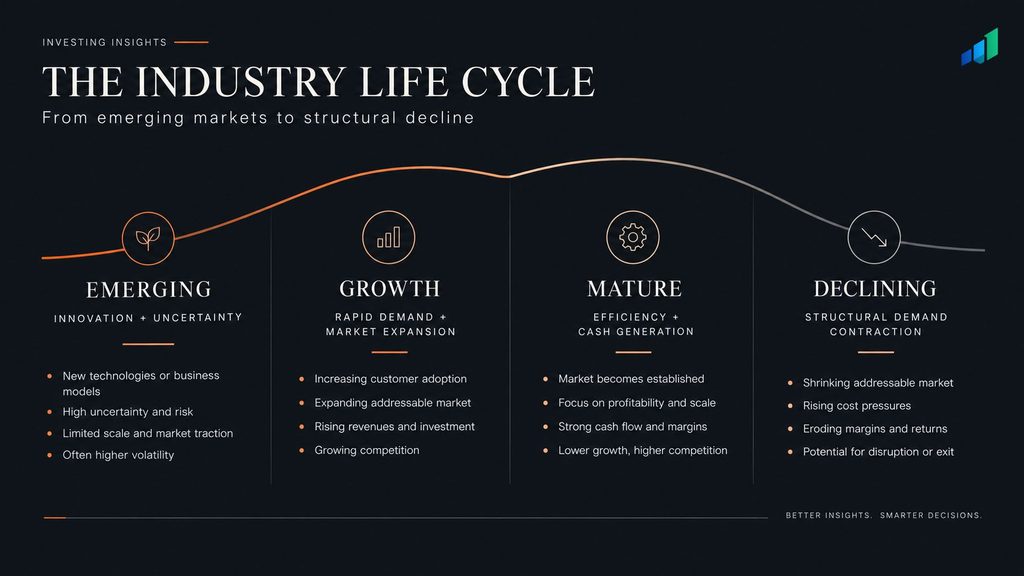
A useful framework is to think about four stages:
1. Emerging
This is the early stage.
Technology is developing, customer adoption is uncertain, and companies are still trying to establish viable business models.
The opportunity can be enormous.
So can the risk.
Many companies competing in emerging industries will never become sustainable businesses.
For investors, this creates a fundamental challenge:
Are you investing in a future market leader—or simply betting on a technology that may not win?
2. Growth
The market begins to validate the underlying product or technology.
Demand accelerates. Revenue grows rapidly. Weaker competitors begin to disappear, and stronger companies start gaining market share.
This is often where some of the largest wealth-creation opportunities in public markets emerge.
But high growth doesn’t automatically make a stock attractive.
The investor still has to determine:
- Who is actually winning?
- How sustainable is the growth?
- Are margins improving?
- Is the company gaining market share?
- How much of the future growth is already reflected in the valuation?
3. Mature
Eventually, the industry becomes established.
The major players are known. Customer acquisition becomes less important than efficiency, retention, pricing, and capital allocation.
Growth typically slows.
But that doesn’t make mature industries unattractive.
Companies in mature industries can generate substantial free cash flow and return capital to shareholders through dividends and share buybacks.
The investment thesis simply changes.
You are no longer primarily paying for explosive growth.
You may instead be investing in stability, cash generation, and durable competitive advantages.
4. Declining
Eventually, structural demand can begin to disappear.
Technology changes. Consumer behavior evolves. Substitutes become more attractive.
But even declining industries can contain interesting businesses.
As weaker competitors leave the market, the remaining companies can sometimes gain market share and pricing power.
This creates a potential last-man-standing dynamic.
The opportunity, however, comes with a major warning:
A company can become more profitable while its underlying industry continues to deteriorate.
That can be a very different investment proposition from owning a business positioned for long-term structural growth.
How attractive is the industry?
Once we understand where an industry sits in its life cycle, we need to understand its competitive environment.
This is where Porter’s Five Forces becomes useful.
The framework asks a simple question:
Where does the economic pressure come from?
1. Competitive rivalry
How intense is the competition?
If dozens of companies sell essentially identical products, businesses may be forced into price competition.
When products are highly differentiated and only a few strong players dominate, profitability can be much more attractive.
The key question is not simply:
How many competitors are there?
It is:
How much economic power does each competitor have?
2. Threat of new entrants
What’s stopping another company from entering the market?
Some industries require enormous capital investments.
Others require specialized technology, regulatory approvals, distribution networks, intellectual property, or years of accumulated expertise.
These barriers can protect established companies.
A business that can be easily replicated is fundamentally different from one that would take billions of dollars and decades to challenge.
3. Bargaining power of customers
Can customers easily leave?
If switching from one provider to another takes five minutes and costs almost nothing, customers have significant bargaining power.
That can limit pricing power.
But if switching requires moving data, retraining employees, rewriting software, changing infrastructure, or disrupting operations, the economics change dramatically.
This is one reason switching costs can become such a powerful competitive advantage.
4. Bargaining power of suppliers
Businesses depend on suppliers too.
If a company relies on a small number of critical suppliers, those suppliers may have significant leverage over pricing and availability.
A business can look extremely attractive from the outside while a critical supplier captures much of the industry’s economics.
Understanding the supply chain is therefore part of understanding the investment.
5. Threat of substitutes
A substitute isn’t necessarily a direct competitor.
Sometimes the biggest threat comes from an entirely different solution.
Digital photography didn’t simply create a better film camera.
It changed the need for film photography altogether.
This is one of the most important risks investors should consider when analyzing industries exposed to technological disruption.
Economic moats: how great businesses defend themselves
If an industry is competitive, how does a company maintain attractive returns over time?
It builds a moat.
An economic moat is a sustainable competitive advantage that makes it difficult for competitors to take away a company’s customers, profits, or market position.
Several types of moats are particularly important.
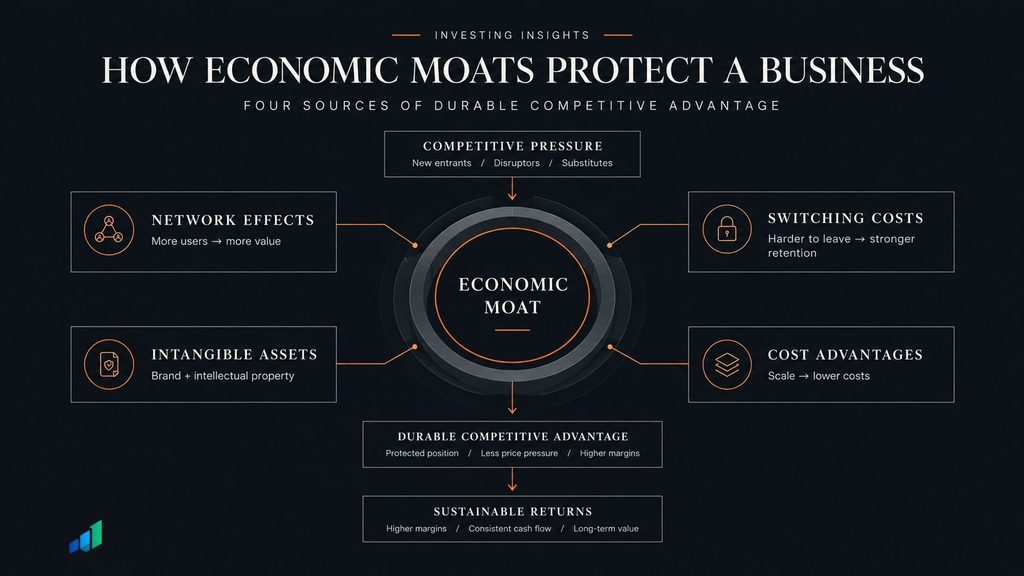
Network effects
A network becomes more valuable as more people use it.
Social platforms, payment networks, and marketplaces can benefit from this dynamic.
The larger the network becomes, the harder it can be for a new competitor to recreate the same value.
Switching costs
Sometimes customers stay not because they love the product, but because leaving would be painful.
Enterprise software is a good example.
Changing providers may involve migrating data, retraining employees, rewriting integrations, and taking on operational risk.
That friction can create durable pricing power.
Intangible assets
Strong brands and intellectual property can create significant barriers to competition.
A powerful brand may allow a company to charge a premium.
Patents can prevent competitors from simply copying a product.
But the important question is whether the asset actually produces an economic advantage—not simply whether the company owns a patent or has a recognizable logo.
Cost advantages
Scale can create another powerful moat.
If a company can produce or distribute something more efficiently than its competitors, it can choose to maintain higher margins or reduce prices and make it difficult for competitors to survive.
Scale can therefore become a self-reinforcing competitive advantage.
Finding the better company among its peers
Suppose you’ve identified an attractive industry.
Now you have two companies operating in that industry.
Both have competitive advantages.
Both benefit from industry growth.
Which one should you own?
This is where relative analysis becomes critical.
Instead of asking whether a company’s numbers look good in isolation, compare them directly with its peers.
Look at:
Revenue growth
Who is gaining market share?
Profit margins
Who converts revenue into profits more efficiently?
Free cash flow
Who turns accounting earnings into actual cash more effectively?
Return on equity
Who is allocating shareholder capital more effectively?
Debt
Who has the stronger balance sheet if economic conditions deteriorate?
Valuation
How much future growth is already reflected in the stock price?
This last point is especially important.
The better business isn’t always the better investment.
A superior company can become a poor investment if investors pay an excessive price for it.
Never compare companies without context
One of the easiest mistakes to make is comparing financial metrics across completely different industries.
A grocery retailer might operate with extremely thin margins.
A software company might have dramatically higher margins.
That doesn’t automatically make the software company better.
Their economics are fundamentally different.
Technology companies tend to be more asset-light and growth-oriented.
Healthcare companies operate within heavy regulation and can be influenced by clinical outcomes.
Banks and insurers are highly sensitive to interest rates and economic conditions.
Consumer companies can benefit from brand loyalty and recurring demand.
Energy and industrial companies are often more capital intensive and more cyclical.
The right comparison is usually between direct peers operating under similar economic conditions.
You want to identify the strongest business relative to its environment.
Not the company with the most impressive number in isolation.
A practical framework for investors
Putting everything together gives us a repeatable process.
Step 1: Identify the sector
What broad part of the economy does the company belong to?
Step 2: Identify the industry
What specific economic environment does the company actually compete in?
Step 3: Determine the industry life-cycle stage
Is the industry:
Emerging → Growing → Mature → Declining?
Step 4: Analyze the competitive forces
Use Porter’s Five Forces to understand where economic pressure comes from.
Step 5: Identify the moat
What protects the company from competitors?
Network effects?
Switching costs?
Brand or intellectual property?
Cost advantage?
Step 6: Compare direct competitors
Look at growth, margins, free cash flow, returns, debt, and valuation.
Step 7: Consider disruption
What technology, regulation, or change in consumer behavior could alter the industry’s economics?
That final step may become increasingly important as artificial intelligence changes the speed at which industries evolve.
Could AI accelerate the industry life cycle?
This is where the framework becomes particularly interesting.
Historically, industries often moved through their life cycles over long periods.
But technological change can accelerate that process.
Artificial intelligence raises a new question:
Could established industries move from maturity to disruption much faster than they have in the past?
Consider industries such as software development, legal discovery, content creation, customer service, and other knowledge-intensive businesses.
The question isn’t simply whether AI will create new companies.
It is whether AI could fundamentally change the economics of entire industries.
For investors, that creates a new dimension of industry analysis.
Instead of asking only:
“Is this industry growing?”
We may increasingly need to ask:
“How structurally prepared is this industry for rapid technological change?”
That could become one of the defining questions for long-term investors.
The investor’s exercise
Here’s a simple exercise you can use to put this framework into practice.
Choose one industry you’re genuinely interested in.
Then select two competing companies operating in that same industry.
Put them side by side.
Compare:
- Revenue growth
- Market share
- Profit margins
- Free cash flow
- Return on equity
- Debt
- Valuation
- Competitive advantages
- Industry positioning
Then ask yourself one question:
If I could own only one of these businesses for the next 10 years, which one would I choose—and why?
The exercise forces you to move beyond daily stock-price movements and think like a long-term owner of a business.
The bigger lesson
Investing isn’t simply about finding great companies.
It’s about understanding the relationship between the company, the industry, and the forces changing the environment around them.
A durable business in an attractive industry, protected by a strong economic moat and purchased at a sensible valuation, is a very different proposition from a great-looking company operating in a structurally declining market.
The goal isn’t to find the perfect company.
It’s to find the strongest business relative to its environment.
And sometimes, the most important investment decision happens before you ever look at the stock ticker.
Listen to the full conversation
Want to go deeper into sector analysis, industry life cycles, Porter’s Five Forces, economic moats, and how to compare competing businesses?
🎧 Listen to Episode 6 of The Wealth Journey on Spotify: How to Pick Winning Industries and Find Economic Moats
The conversation explores the framework in greater depth, including how artificial intelligence could change the speed at which industries move through their life cycles.
The Wealth Journey is a podcast about investing, markets, business fundamentals, and the frameworks that can help investors make better long-term decisions.
Educational content only. This podcast and article are not investment advice.
Take your research further
Go deeper with Evolty.
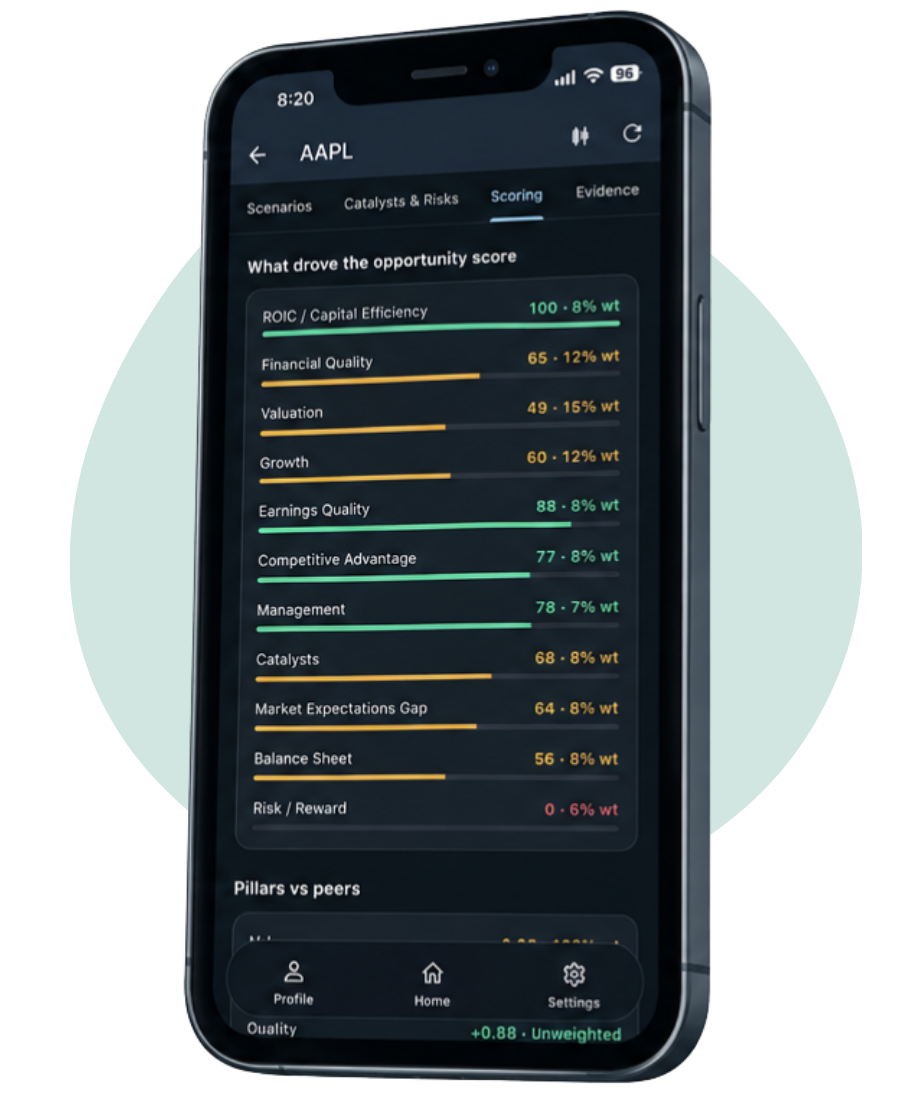
A stock’s story goes beyond its headline price. Explore what drives a company’s performance, what the market expects, and what risks could change the picture.
Explore valuation, financial performance and growth expectations.
Compare peers, competitive advantages, risks and potential catalysts.
Bring multiple perspectives together before making your own investment decisions.
Start exploring stock research with Evolty.