



Anthropic’s Trillion-Dollar IPO: What the Financials Really Reveal
Explosive revenue growth. An $80.7 billion net loss. A breakthrough quarter in operating profitability. Behind Anthropic’s IPO headlines lies a much more complicated investment story.
Anthropic, the artificial intelligence company behind Claude, has reached a defining moment.
On October 26, 2026, the company publicly filed its Form S-1 with the U.S. Securities and Exchange Commission, opening a new chapter in the race to bring frontier AI companies to public markets.
The numbers are extraordinary.
Anthropic reported $16.3 billion in revenue during the first six months of 2026, compared with approximately $1.2 billion during the same period in 2025. Yet its financial statements also show an $80.7 billion net loss.
At first glance, those figures seem almost impossible to reconcile.
How can a company grow at such extraordinary speed while reporting losses many times larger than its revenue? And what would justify a potential valuation approaching $1 trillion?
The answer requires looking beyond headline figures and examining the economics of the business itself.
This is not simply a story about another technology IPO. It is a case study in how investors should evaluate growth, profitability, capital intensity, competitive advantages, and market expectations.
1. The Growth Story: From AI Research to Enterprise Scale
Anthropic’s revenue trajectory illustrates how rapidly demand for commercial AI capabilities has accelerated.
Consider its quarterly revenue progression:
| Period | Reported Revenue |
|---|---|
| Q1 2025 | $376 million |
| Q2 2025 | $787 million |
| Q1 2026 | $4.73 billion |
| Q2 2026 | $11.56 billion |
In just five quarters, quarterly revenue increased more than thirtyfold.
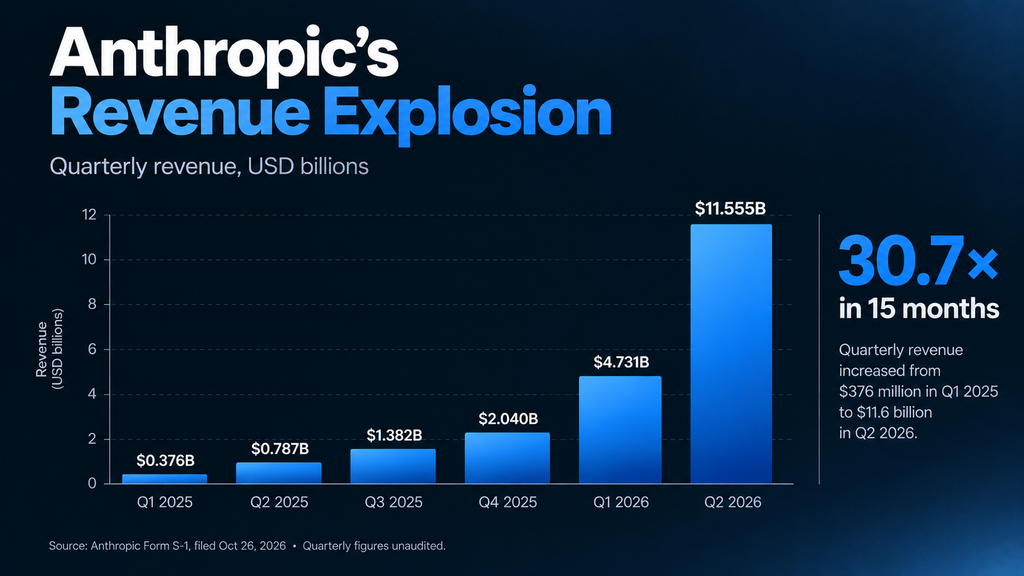
This growth reflects Anthropic’s evolution from an AI research company into a commercial platform serving enterprises, developers, and organizations integrating AI into their operations.
Its products increasingly support coding, knowledge work, automation, and other business workflows.
But revenue growth, no matter how impressive, is only the beginning of the investment analysis.
The critical question is not how quickly revenue is growing today, but how much of that growth can translate into durable economic value.
When evaluating a rapidly expanding company, investors should distinguish between three dimensions:
- Growth: How rapidly is demand increasing?
- Profitability: How much revenue remains after the cost of delivering the service and running the business?
- Durability: Can the company maintain its competitive position as the market evolves?
A company can perform exceptionally well on the first dimension while remaining vulnerable on the other two.
That distinction becomes especially important in artificial intelligence.
2. Understanding the $80.7 Billion Loss
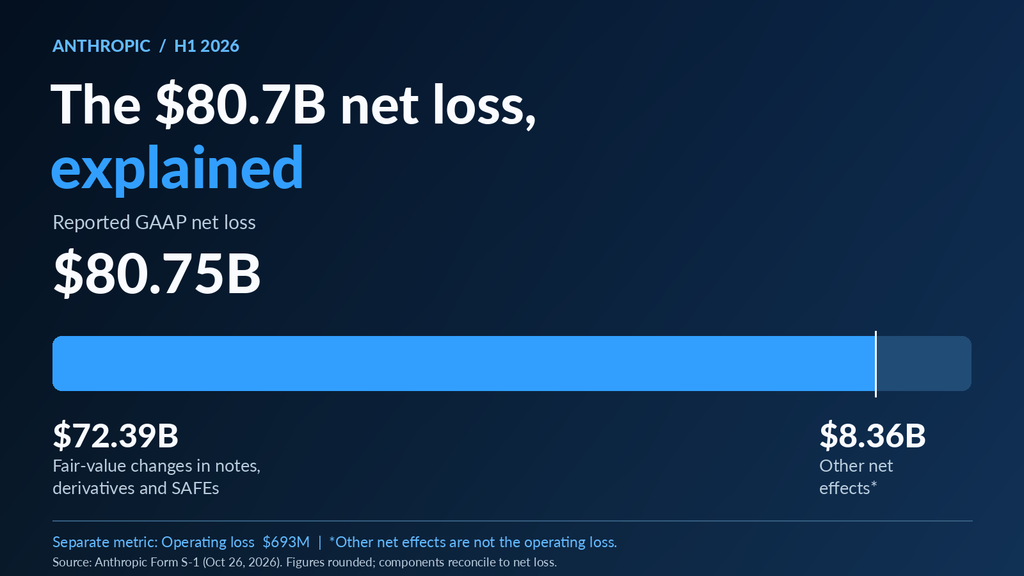
One of the most striking figures in Anthropic’s IPO filing is its reported net loss of approximately $80.7 billion during the first half of 2026.
It is also one of the figures most likely to be misunderstood.
The filing indicates that approximately $72.4 billion of that loss resulted from changes in the fair value of convertible notes, derivative liabilities, and similar financing instruments.
Why Does This Matter?
Some startups raise capital through financial instruments whose accounting value changes as the company’s valuation increases.
Under the applicable accounting treatment, increases in the fair value of certain obligations can create substantial expenses on the income statement.
Importantly, these adjustments do not necessarily represent cash paid out during the reporting period.
In Anthropic’s case, the rapid increase in the company’s valuation contributed to an enormous reported accounting charge.
This creates an unusual situation: a business can experience extraordinary commercial growth while simultaneously recognizing significant non-cash losses linked to its financing arrangements.
Non-Cash Does Not Mean Irrelevant
It would be equally misleading to conclude that the loss does not matter.
Non-cash financing adjustments can reveal information about the company’s capital structure, financing obligations, and the economic interests of investors.
Furthermore, removing these adjustments does not automatically make Anthropic profitable.
For the first six months of 2026, the company still reported an operating loss of approximately $693 million.
The investor lesson: Net income, operating income, and cash flow answer different questions. A sound analysis considers all three.
When examining an income statement, always identify what is driving the result before deciding what the headline number means.
3. The Profitability Breakthrough: Can AI Economics Actually Work?
Anthropic’s second-quarter results reveal another important development.
In Q2 2026, the company reported approximately $974 million in operating income, representing an operating margin of about 8%.
This marked a significant improvement from its earlier operating losses.
Why is that important?
Traditional software businesses often benefit from substantial operating leverage. Once a software product is developed, the incremental cost of serving additional customers can be relatively low.
Frontier AI works differently.
Each request requires computing resources. More customers and more usage can translate into greater spending on chips, servers, energy, networking, and infrastructure.
That makes unit economics especially important.
Understanding Operating Leverage in AI
Operating leverage occurs when revenue grows faster than the expenses required to support it.
For an AI business, improving operating leverage may depend on several factors:
- More efficient models that require less computation.
- Better utilization of available infrastructure.
- Routing simpler tasks to less expensive models.
- Increasing enterprise usage without proportionally increasing fixed expenses.
- More favorable infrastructure procurement and deployment.
Anthropic’s results suggest meaningful progress in managing these costs.
However, one profitable quarter does not establish a sustainable long-term margin.
The company continues to face significant expenses related to research, personnel, customer acquisition, and infrastructure expansion.
The important distinction is between demonstrating that profitability is possible and proving that profitability is durable.
Investors need evidence of both.
4. The Real Economics of AI: Revenue Is Only Half the Equation
One of the most important questions facing frontier AI companies is whether the cost of delivering intelligence can decline faster than the price customers pay for it.
This creates a fascinating economic tension.
As AI models become more efficient, companies may deliver increasingly capable services at lower operating costs.
But competition can also force providers to lower their prices.
The resulting profitability depends on which effect dominates.
When Lower Costs Don’t Mean Higher Profits
Consider a simplified example.
Suppose an AI company receives $100 in revenue from a group of workloads and spends $60 delivering them.
Its gross contribution before other operating expenses is $40.
If engineering improvements reduce the delivery cost to $40 while revenue remains unchanged, that contribution increases to $60.
But if competitive pressure simultaneously reduces revenue to $70, the contribution becomes $30.
The technology improved, yet the economics deteriorated.
This is why declining inference costs are not automatically equivalent to increasing profitability.
What matters is the relationship between revenue per workload, cost per workload, and total demand.
Anthropic’s ability to deploy different model capabilities and computing infrastructure may help it improve operational efficiency.
Still, the long-term outcome depends on pricing, competition, utilization, and customer behavior.
For investors, understanding this relationship is more useful than focusing exclusively on model performance benchmarks.
5. Enterprise Adoption: A Competitive Advantage or a Temporary Lead?
Anthropic’s filing reveals substantial enterprise adoption.
As of September 30, 2026, the company reported:
- More than 11,900 customers generating at least $100,000 in trailing-twelve-month revenue.
- More than 1,900 customers generating at least $1 million.
- Approximately 250 customers generating at least $10 million.
These figures suggest that Anthropic is attracting more than casual users experimenting with new AI tools.
Organizations are increasingly deploying Claude in commercially significant environments.
But enterprise adoption introduces another important investment question.
Does Adoption Create a Durable Competitive Moat?
A competitive moat is an advantage that helps a business defend its economic position against competitors.
For an enterprise AI provider, potential sources of competitive advantage include:
Workflow Integration
As AI becomes part of internal business processes, replacing a provider may require additional engineering work, testing, and organizational change.
Trust and Governance
Businesses may prioritize reliability, security, compliance, and operational controls when selecting AI vendors.
Developer Ecosystems
Tools, integrations, and established development practices can increase the practical costs of switching platforms.
Product Performance
Consistent quality and improvements in model capabilities may support customer retention.
However, none of these advantages is automatically permanent.
Enterprises can adopt multiple AI providers. Model capabilities can converge. And pricing pressure may reduce the value of customer relationships.
The key question is whether Anthropic can maintain pricing power and customer retention as competition intensifies.
A large customer base is evidence of adoption. A sustainable moat requires evidence that the company can defend the economics of those relationships.
6. The Infrastructure Question: Growth Today, Obligations Tomorrow
Artificial intelligence is not only a software business.
At the frontier, it is also an infrastructure-intensive industry.
Anthropic depends on extensive computing capacity to train, operate, and improve its models.
Its relationships with major cloud and semiconductor providers give it access to important resources and distribution channels.
But these relationships also introduce strategic dependencies.
Amazon and Google, for example, participate in the AI ecosystem as infrastructure providers, investors, distribution partners, and competitors.
This arrangement creates both opportunities and risks.
Why Long-Term Compute Commitments Matter
Anthropic’s IPO disclosures describe infrastructure commitments extending as far as 2045.
The implication is significant.
Infrastructure capacity secured today may support future growth, but long-term obligations must be assessed against uncertainty in demand, technology, and pricing.
Potential risks include:
- Changes in the cost or availability of computing resources.
- Lower-than-expected demand for AI services.
- New technical approaches that make existing infrastructure less competitive.
- Rising competition from companies that control their own computing infrastructure.
- Financial obligations that remain substantial even if revenue growth slows.
Access to computing resources can help a business scale.
But infrastructure commitments are not automatically competitive advantages.
Their value depends on whether the company can generate sufficient economic returns from the capacity it secures.
The real investment question is whether the infrastructure creates future earning power greater than its long-term cost.
7. The Valuation Challenge: What Would $1 Trillion Require?
A potential trillion-dollar valuation is an ambitious benchmark.
As of October 31, 2026, Anthropic’s proposed IPO price range and final offering valuation have not been officially determined.
Nevertheless, the prospect of a valuation at this scale creates an opportunity to examine market expectations.
A high valuation is not simply a statement about how successful a company is today.
It reflects expectations about future revenue, margins, competitive advantages, reinvestment needs, and risk.
Why a Revenue Multiple Is Only a Starting Point
Suppose a company is valued at $1 trillion.
If its annual revenue were $50 billion, its price-to-sales multiple would be 20 times.
That does not tell investors whether the company is expensive or inexpensive in isolation.
The interpretation depends on how much of that revenue can eventually convert into free cash flow.
A business with recurring revenue, high margins, limited capital requirements, and strong customer retention may justify a very different valuation from a business that needs continuous infrastructure investment to maintain growth.
For Anthropic, investors must ask whether its economics will eventually resemble a high-margin software platform, a capital-intensive infrastructure provider, or a combination of both.
That distinction could materially affect the valuation the market is willing to support.
What Expectations Are Already Embedded in the Price?
Before evaluating any IPO, investors should consider:
- How much future growth does the valuation require?
- What operating margins must the business eventually achieve?
- How much reinvestment will be necessary?
- What competitive position must the company preserve?
- What happens if growth or profitability falls short?
The last question is particularly important.
A great company is not necessarily a great investment at every price.
8. Three Possible Futures for Anthropic
Rather than relying on a single optimistic forecast, investors can evaluate the business through multiple scenarios.
These are illustrative possibilities, not probability-weighted predictions.
Bull Case: AI Becomes Essential Enterprise Infrastructure
Enterprise demand continues expanding rapidly.
Anthropic improves computing efficiency, deepens customer relationships, and sustains stronger operating margins.
Its platform becomes increasingly embedded in business workflows, supporting recurring usage and meaningful pricing power.
In this scenario, higher long-term cash generation could support an ambitious valuation.
Base Case: Strong Growth Meets Increasing Competition
Anthropic continues growing, but the pace moderates as its revenue base becomes larger.
Competition places pressure on pricing, while infrastructure and research spending remain substantial.
Operating margins improve over time but fluctuate with investment cycles.
The company builds a valuable business, although its ultimate financial performance may not justify the most aggressive valuation expectations.
Bear Case: Costs and Competition Outpace Monetization
AI services become more commoditized.
Pricing declines faster than operating costs, customer switching increases, and infrastructure obligations limit financial flexibility.
Revenue may continue growing while free cash flow remains insufficient relative to investment requirements.
In this scenario, the company could achieve commercial success without delivering the financial returns implied by a very high valuation.
What Should Investors Monitor?
The most useful indicators include revenue growth, operating margins, free cash flow, customer retention, capital requirements, and the relationship between AI pricing and delivery costs.
These metrics can help determine which scenario the company’s actual performance is beginning to resemble.
9. What Anthropic Teaches Us About Analyzing Stocks
Anthropic’s IPO provides lessons that extend far beyond artificial intelligence.
It demonstrates why investment research requires more than reading a headline or observing a company’s growth rate.
A disciplined process connects the business model to financial performance, valuation, and future expectations.
When studying a company, ask:
What is driving growth?
Understand the source of customer demand, recurring revenue, and market expansion.
How profitable is the business?
Examine operating margins and distinguish ongoing operating performance from unusual accounting effects.
How much cash does growth require?
Consider the relationship between operating cash flow, capital investment, and external financing.
What protects the business from competition?
Evaluate switching costs, customer relationships, differentiation, and pricing power.
What assumptions justify the valuation?
Compare the current price with a realistic range of possible future outcomes.
These questions form the foundation of a stronger investment thesis.
Put the Framework into Practice with Evolty Stock
You do not need to rely on headlines or scattered financial metrics to begin researching a stock.
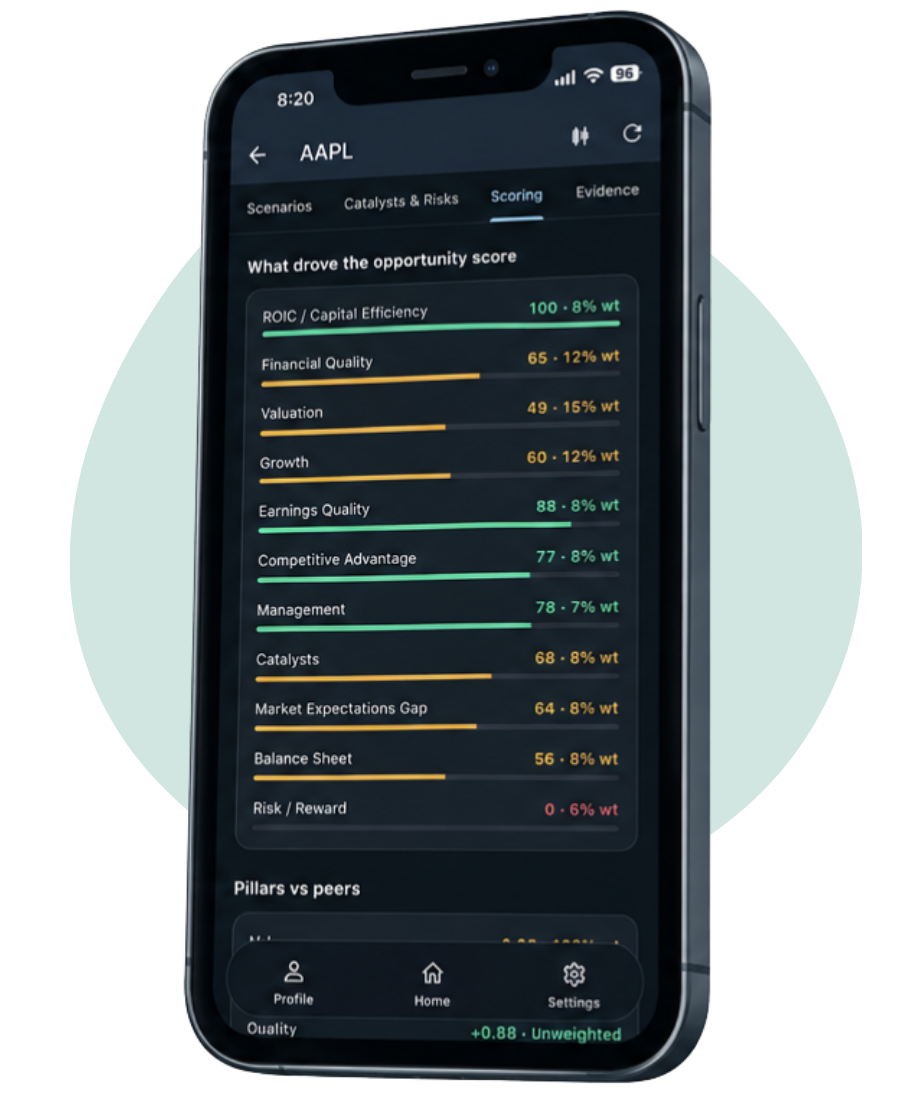
Evolty Stock helps you explore publicly traded U.S. companies through an integrated research framework that brings together investment theses, valuation expectations, scenarios, catalysts, risks, and peer comparisons.
Explore the businesses, the assumptions, and the possible outcomes behind a stock’s market price.
The app is free to start, with 10 research searches available daily.
Explore Evolty Stock: https://evolty.net
Anthropic’s proposed ticker, ANT, is not yet publicly trading as of this article’s publication. Use the framework to research already-listed U.S. companies while following Anthropic’s IPO developments.
10. Go Deeper: Listen to the Podcast
Anthropic’s Trillion-Dollar IPO: Growth, Profits & Hidden Risks
In Episode 10 of our podcast, we examine the financial and strategic questions behind one of the most closely watched IPOs in technology.
From Anthropic’s extraordinary revenue growth to its unusual accounting losses, infrastructure commitments, and competitive challenges, the episode explores what investors should understand before evaluating the company’s potential market debut.
Listen to Episode 10 on Spotify and explore the full discussion.
Discover more financial education, stock research insights, and investing resources at:
Final Thoughts: Beyond the AI Hype
Anthropic’s financial disclosures illustrate a fundamental tension in the artificial intelligence industry.
Demand is expanding at an extraordinary pace, but delivering increasingly sophisticated AI remains capital intensive.
The company has demonstrated remarkable commercial growth and meaningful progress toward profitability.
Yet important questions remain about the durability of its margins, the economics of its infrastructure commitments, its competitive position, and the expectations that investors may ultimately be asked to pay for.
The broader lesson is not that AI companies are necessarily overvalued or undervalued.
It is that understanding a company requires separating business performance, accounting results, cash generation, and market expectations.
Because the most important question in investing is rarely whether a company has an exciting future.
It is whether that future justifies the price.
Take your research further
Go deeper with Evolty.
A stock’s story goes beyond its headline price. Explore what drives a company’s performance, what the market expects, and what risks could change the picture.
Explore valuation, financial performance and growth expectations.
Compare peers, competitive advantages, risks and potential catalysts.
Bring multiple perspectives together before making your own investment decisions.
Start exploring stock research with Evolty.
Sources & Further Reading
Anthropic, PBC — Form S-1 Registration Statement
Filed October 26, 2026.
https://www.sec.gov/Archives/edgar/data/2130357/000162828026067168/anthropicpbc-sx1.htm
Anthropic — Official IPO Filing Announcement
https://www.anthropic.com/news/s1-sec
Important Information
This article is provided for informational and educational purposes only and does not constitute investment advice, a recommendation to buy or sell securities, or an offer to participate in any public offering.
Financial figures are based on information available as of October 31, 2026. Actual future results may differ materially from illustrative scenarios. Investing involves risk, including the possible loss of principal.
Evolty is an independent research and educational platform and is not affiliated with or endorsed by Anthropic.