



The 100-Point Stock Analysis Framework: How to Evaluate Quality, Value, and Competitive Moats
How can investors distinguish great businesses from great investments? A systematic framework can help you look beyond market hype, measure business fundamentals, and identify the gap between a stock’s price and its underlying value.
From Stock Hype to Fundamental Analysis
Imagine opening your brokerage app and seeing a technology stock jump 15% in a single afternoon. The immediate temptation is to buy before the opportunity disappears. Everyone seems to know something you don’t, and the fear of missing out starts influencing your decision.
But a rising stock price doesn’t necessarily mean the underlying business is becoming more valuable.
Markets are emotional. Investors frequently chase recent performance, anchor their expectations to short-term price movements, and mistake momentum for lasting business strength.
A more disciplined approach starts with a different question: If I were buying this entire business rather than trading its stock, what would I need to know?
That shift in perspective is the foundation of systematic stock analysis. Instead of trying to predict tomorrow’s price movement, investors can evaluate a company’s ability to generate sustainable cash flows, reinvest capital productively, defend its competitive position, and compound intrinsic value over time.
In this article, we explore a weighted 100-point stock analysis framework and apply its principles to Microsoft. We also examine an increasingly important challenge: whether artificial intelligence could weaken the competitive advantages that investors have historically relied on to identify exceptional businesses.
1. Why a 100-Point Framework Changes the Way You Evaluate Stocks
A structured scoring model introduces consistency into a process that can otherwise be dominated by emotion and narrative.
Rather than relying on a compelling story, a trending stock, or a single financial metric, the framework evaluates multiple dimensions of a company’s economic performance and investment potential.
The underlying principle is straightforward: business quality, financial strength, valuation, and the potential for future returns must be evaluated together.
A company can have excellent products, strong revenue growth, and a dominant market position while still being a poor investment if its stock price already assumes years of exceptional performance.
Likewise, a company trading at an apparently attractive valuation may not be a genuine opportunity if its competitive position is deteriorating or its cash generation is weak.
The framework helps investors separate these considerations instead of allowing one attractive characteristic to overshadow the others.
2. The Core Business: Growth and Return on Invested Capital
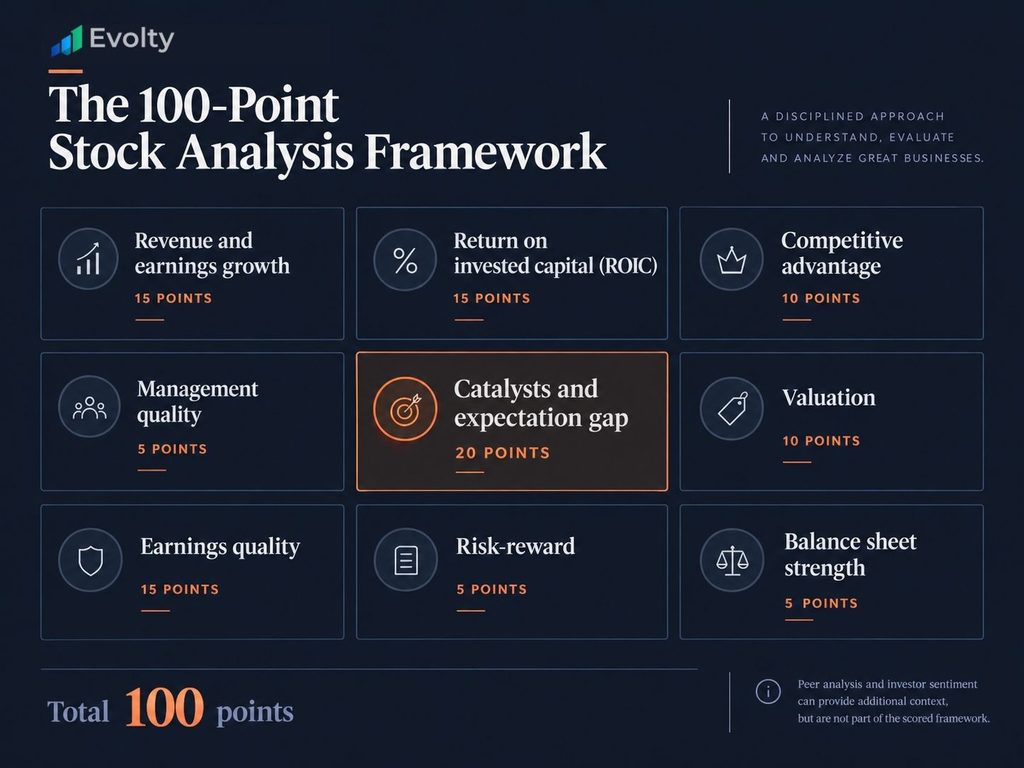
The first two pillars receive 30 points combined, reflecting the importance of understanding how a business grows and how efficiently it uses the capital available to it.
Revenue and earnings growth — 15 points
Sustainable growth matters more than a temporary improvement in a single quarter.
A useful analysis examines three-year and five-year compound annual growth rates (CAGR) across several measures:
- Revenue growth
- Earnings per share (EPS) growth
- Free cash flow growth
Looking at these metrics together helps investors determine whether expansion is translating into stronger financial performance and cash generation.
Microsoft provides an illustrative example. Its cloud business, Azure, has been an important growth engine, demonstrating how a company can expand beyond its original product categories and develop additional sources of revenue.
However, historical growth should not be treated as a guarantee of future performance. Investors must still assess whether the growth drivers remain sustainable and how much future expansion the market already expects.
Return on invested capital (ROIC) — 15 points
Growth alone does not guarantee value creation.
Return on invested capital measures how effectively a company generates operating returns from the capital invested in its business. The critical comparison is between ROIC and the company’s cost of capital.
When ROIC consistently exceeds the cost of capital, the business has the potential to create economic value as it grows. When returns remain below the cost of capital, expansion can consume resources without generating sufficient economic returns.
For example, if a company earns a 7% return on invested capital while its cost of capital is 8%, additional investment at similar returns would tend to destroy economic value.
This is why investors should not automatically reward a company for expanding revenue. The more important question is whether each additional dollar invested generates an attractive return.
The takeaway: Growth tells you whether a business is expanding. ROIC helps you understand whether that expansion creates value.
3. Competitive Moats and Management Quality
High returns attract competitors. When a company demonstrates attractive margins and strong returns on capital, rivals have an incentive to replicate its products, compete on price, and capture some of its profits.
The next question is whether the business has a durable advantage that protects its economics.
Competitive advantage — 10 points
A competitive moat is a structural advantage that makes it difficult for competitors to take away a company’s customers, profits, or market position.
Common sources include:
- Switching costs that make moving to another provider expensive or disruptive.
- Pricing power that allows a company to raise prices without losing customers disproportionately.
- Network effects that make a product more valuable as participation grows.
- Brand strength, proprietary assets, and other defensible advantages.
Consider the toll bridge analogy. Building a bridge requires a substantial initial investment, but once it is established, each additional vehicle can generate revenue without requiring the bridge to be rebuilt.
A competitor cannot necessarily replicate that economics easily, particularly when regulatory barriers or geographic constraints limit alternatives.
Microsoft illustrates a different mechanism: switching costs.
For a large enterprise using Windows, Microsoft 365, Teams, and Azure, moving to competing systems can involve substantial migration costs, operational disruption, integrations, and employee retraining.
Those switching costs can help protect customer relationships and support pricing power. The important analytical question is not simply whether customers use a company’s products, but how difficult and costly it would be for them to leave.
Management quality — 5 points
A strong business can still destroy shareholder value through poor capital allocation.
Management decides how profits are deployed: reinvestment, acquisitions, dividends, share repurchases, or other strategic initiatives.
Investors should examine the company’s historical decisions rather than relying exclusively on management’s promises.
Useful questions include:
- Have acquisitions generated attractive returns?
- Has management invested in businesses that strengthen the company’s competitive position?
- Are capital allocation decisions consistent with long-term shareholder value creation?
- Has the company avoided expensive acquisitions driven by ambition rather than sound economics?
Microsoft’s strategic evolution under Satya Nadella, including its cloud expansion and investments in AI, provides a useful case for examining how capital allocation can reshape a company’s growth opportunities.
4. Valuation: When a Great Business Becomes a Poor Investment
Valuation receives 10 points in this framework, but its significance extends beyond the score itself.
Even an exceptional company can deliver disappointing investment returns when purchased at an excessive price.
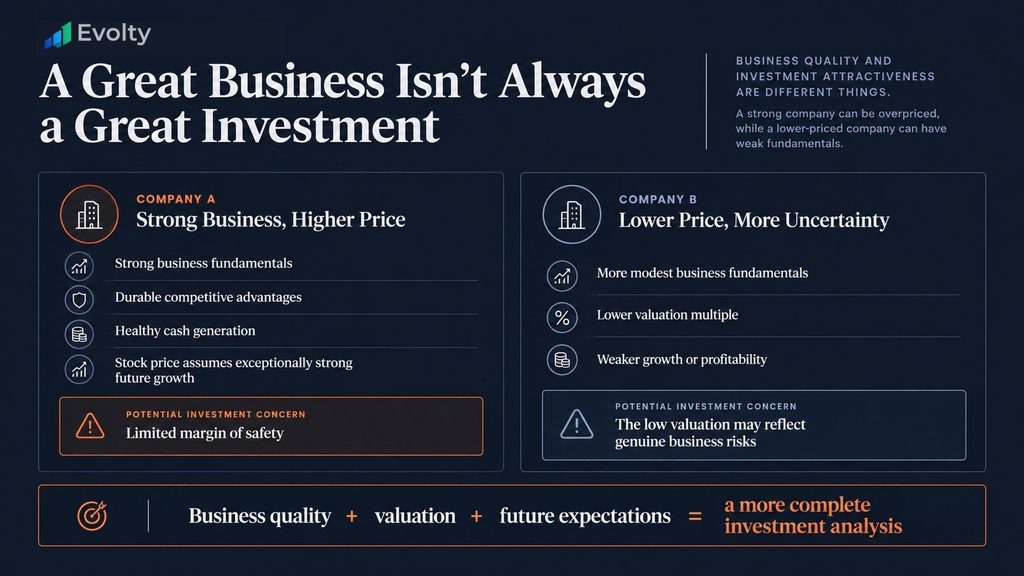
The central question is: What future performance is already reflected in the current stock price?
Looking beyond the P/E ratio
The price-to-earnings (P/E) ratio is a widely used valuation measure, but it does not tell the entire story.
Enterprise value (EV) provides another perspective by accounting for a company’s equity value and net debt. Comparing enterprise value with EBITDA can help investors evaluate the value of the overall business relative to an operating earnings measure.
No single multiple determines whether a stock is cheap or expensive. Valuation should be considered alongside growth expectations, profitability, cash generation, capital requirements, and the company’s risk profile.
For example, two businesses may trade at similar earnings multiples but have very different growth prospects, debt levels, and cash conversion. Their investment merits may therefore differ considerably.
Margin of safety
A margin of safety means purchasing an investment at a price that leaves room for errors in assumptions, unexpected setbacks, or weaker-than-expected performance.
The goal is not to predict the future perfectly. It is to avoid paying a price that requires everything to go right.
For Microsoft, strong business fundamentals do not automatically establish that the stock is attractively valued. Investors must also assess how much of its future growth and competitive strength is already reflected in the market price.
5. Earnings Quality: Does the Profit Turn Into Cash?
The framework allocates 15 points to financial quality, emphasizing the importance of distinguishing reported earnings from the cash a business actually generates.
Accounting profits can be affected by estimates, accounting policies, and noncash items. Cash flow provides a complementary view of the economics of the business.
A company reporting strong earnings growth while operating cash flow remains flat or declines deserves closer examination.
Investors should consider:
- Operating cash flow relative to reported earnings.
- Free cash flow generation and its consistency over time.
- Whether growth requires increasingly large capital expenditures.
- Whether working capital changes are affecting cash generation.
- Whether reported profitability is supported by the underlying business.
Free cash flow is particularly useful because it helps show how much cash remains after capital expenditures, although investors should still account for the business’s future investment requirements.
Microsoft serves as an example of a business whose cash-generating ability is an important part of its investment case.
The broader lesson is simple: earnings tell part of the story; cash flow helps test whether the story holds up.
6. Catalysts and Market Expectations: What Could Change the Story?
A high-quality business purchased at a reasonable valuation can still produce disappointing returns if the market has already anticipated its future success.
This is why the framework assigns a combined 20 points to catalysts and gaps between market expectations and potential outcomes.
A catalyst is an event or structural change that could materially alter how the market evaluates a company.
Examples include:
- A new product that opens a significant market.
- A strategic shift that improves profitability.
- The sale of an underperforming business.
- Cost reductions that improve operating efficiency.
- A technological development that changes the company’s growth trajectory.
However, identifying a positive development is not enough. Investors must ask whether that development is already reflected in the stock price.
The expectation gap
A useful analysis begins with two questions:
- What does the market currently expect from this business?
- What do the underlying fundamentals suggest could happen instead?
An opportunity may emerge when market expectations are too pessimistic relative to the business’s actual prospects. Conversely, a company can execute well and still disappoint investors if its results fall short of an extremely optimistic consensus.
Microsoft’s AI investments and integration of AI into its enterprise software illustrate this tension. AI may create substantial opportunities, but its existence alone does not establish an attractive investment opportunity.
Investors must determine whether the potential benefits exceed what the market already anticipates.
7. Risk-Reward: Evaluate Multiple Possible Outcomes
The framework assigns 5 points to risk-reward dynamics.
Rather than asking whether a stock can rise, investors should examine the range of plausible outcomes and compare the potential upside with the potential downside.
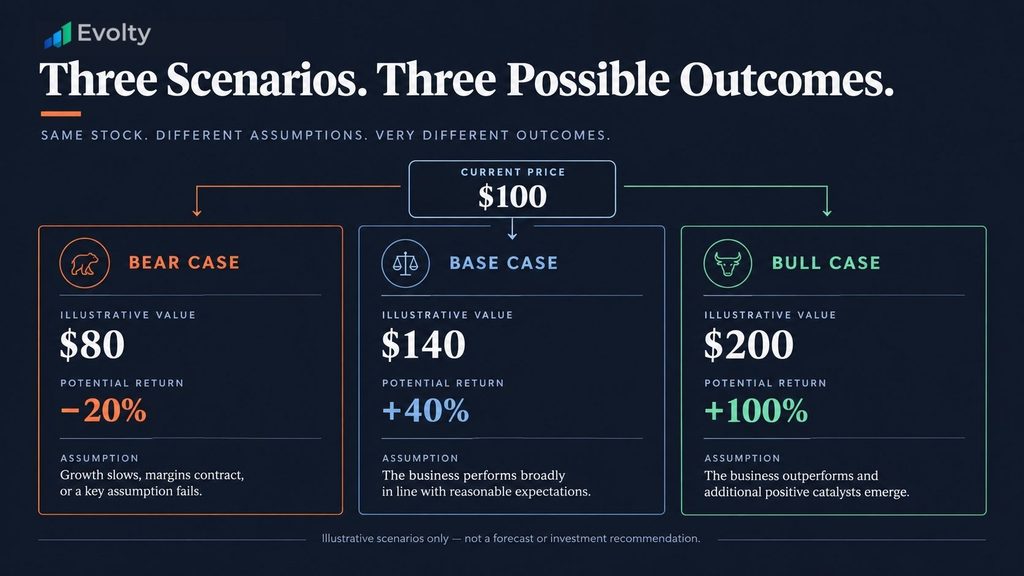
A scenario-based approach typically considers three cases:
- Bear case: What happens if growth slows, margins contract, or a key assumption fails?
- Base case: What happens if the company performs broadly in line with reasonable expectations?
- Bull case: What happens if the business outperforms and additional catalysts emerge?
Consider a hypothetical stock trading at $100:
| Scenario | Illustrative value | Return |
|---|---|---|
| Bear case | $80 | -20% |
| Base case | $140 | +40% |
| Bull case | $200 | +100% |
These figures are illustrative, not a forecast for any specific company.
The exercise helps investors evaluate whether the potential reward justifies the risks being taken. It also exposes investments whose optimistic outcomes depend on assumptions that may be difficult to achieve.
An attractive investment is not necessarily one with the highest possible upside. It is one where the range of plausible outcomes offers a compelling relationship between potential returns and potential losses.
8. Balance Sheet Strength: Can the Business Survive a Downturn?
Balance sheet strength receives 5 points.
A company may perform exceptionally well during favorable economic conditions but become vulnerable when interest rates rise, credit markets tighten, or demand weakens.
Investors should examine measures such as:
- Debt-to-equity ratio.
- Net debt-to-EBITDA.
- Interest coverage.
- Cash reserves and liquidity.
- The timing and flexibility of debt repayments.
The right interpretation depends on the industry and business model. Capital-intensive companies, financial institutions, and subscription software businesses can have very different balance sheet characteristics.
A strong balance sheet provides more than protection against financial distress. It can also create strategic flexibility, allowing a company to continue investing during a downturn or acquire assets when weaker competitors are under pressure.
Financial resilience therefore matters both defensively and offensively.
9. Peer Analysis and Investor Sentiment: Putting the Numbers in Context
A company should not be evaluated in isolation.
Peer analysis helps determine whether its apparent strengths are genuinely differentiated or simply reflect industry-wide conditions.
For example, a cloud business reporting attractive margins may appear impressive until investors compare those margins with competitors offering similar services.
Relevant comparisons may include:
- Revenue and earnings growth.
- ROIC and operating margins.
- Cash flow conversion.
- Valuation multiples.
- Competitive positioning and customer retention.
Investor sentiment and short-term price momentum provide additional context, but they should not replace fundamental analysis.
Analyst estimate revisions, short interest, and institutional activity may help investors understand how expectations are changing. However, these signals are not reliable substitutes for evaluating the underlying business.
Sometimes negative sentiment creates an opportunity when the fundamentals remain sound. In other cases, pessimism reflects a genuine deterioration in the company’s prospects.
The distinction requires analysis rather than automatically betting against the crowd.
10. The AI Paradox: Can Technology Destroy a Competitive Moat?
The final question goes beyond Microsoft’s valuation or any single company’s financial statements.
Artificial intelligence can help businesses develop products faster, improve productivity, and create new revenue streams. At the same time, it may reduce the cost of replicating certain products, services, and intangible assets.
That creates a challenge for traditional competitive analysis.
If software can be reproduced more easily, does an established software company’s advantage become less durable? If AI reduces barriers to entry, how might that affect future pricing power and profitability?
The answer will depend on the source of each company’s competitive advantage.
A product that can be replicated relatively easily may be more vulnerable than a business protected by deep customer integration, proprietary data, network effects, regulatory requirements, or substantial switching costs.
Even those advantages must be reassessed as technology evolves.
Investors should therefore avoid treating a moat as a permanent characteristic. Instead, they should examine the mechanism behind the advantage and ask whether it is likely to remain effective as competitors adopt new technologies.
For Microsoft, the analysis involves weighing the opportunities created by AI against the possibility that AI changes the economics of software, enterprise services, and competition itself.
This is not simply a question of whether AI will help or hurt a company. It is a question of which advantages remain defensible, for how long, and at what price investors should value them.
Conclusion: A Repeatable Process Beats Investment Hype
A 100-point framework provides a structured way to bring business quality, capital efficiency, competitive advantages, management, valuation, cash generation, catalysts, risk-reward, and financial resilience into a single investment process.
Its greatest value is not the numerical score alone. It is the discipline required to explain why a business deserves that score and which assumptions could change the conclusion.
Before investing, consider whether the company is growing profitably, generating real cash, protecting its competitive position, and trading at a price that offers a reasonable margin of safety.
Then ask what the market already expects—and what could cause reality to turn out differently.
Finally, reassess whether technological change, especially AI, could strengthen or undermine the advantages on which your investment thesis depends.
No framework can eliminate uncertainty or guarantee investment returns. But a repeatable analytical process can help investors make more informed decisions and avoid confusing an exciting stock story with a compelling investment opportunity.
The objective is not simply to find great companies. It is to identify businesses whose future economic performance justifies the price you pay for them.
Take your research further
Go deeper with Evolty.
A stock’s story goes beyond its headline price. Explore what drives a company’s performance, what the market expects, and what risks could change the picture.
Explore valuation, financial performance and growth expectations.
Compare peers, competitive advantages, risks and potential catalysts.
Bring multiple perspectives together before making your own investment decisions.
Start exploring stock research with Evolty.
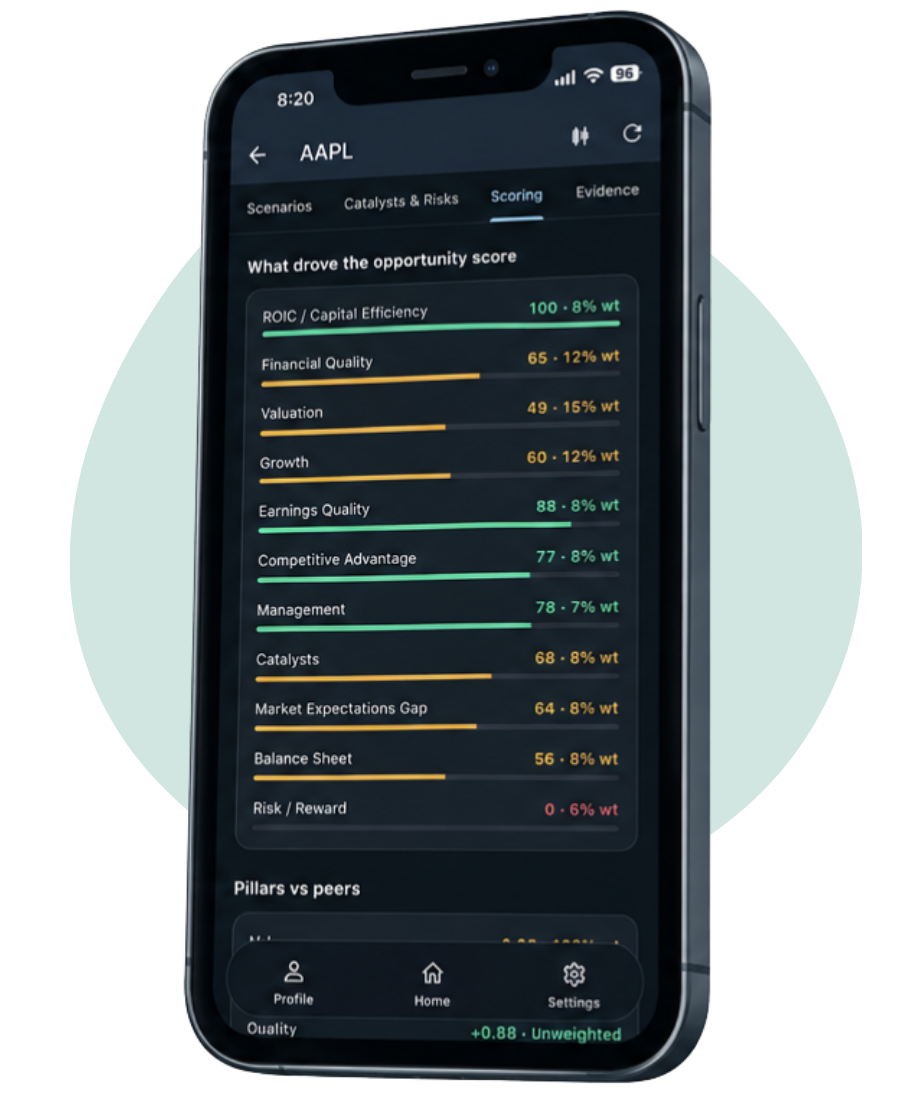
Listen to the Full Episode
Prefer to hear the discussion? 🎧 Listen to Episode 8 of The Wealth Journey, where we explore the 100-point stock analysis framework, walk through the Microsoft example, and examine the questions AI raises about competitive advantages.
Disclaimer: This article is for educational and informational purposes only and does not constitute financial or investment advice. The scoring framework is an analytical tool, not a guarantee of investment performance. Examples and hypothetical scenarios are illustrative and should not be interpreted as current valuations, price targets, or recommendations to buy or sell any security. Always conduct your own research and consider your financial circumstances before making investment decisions.