

How to Read SEC Filings Like a Pro Investor
What if the most useful information about a public company isn’t on financial television, social media, or the latest market headline?
It may already be sitting in the company’s SEC filings.
For investors willing to go beyond the noise, filings such as the 10-K, 10-Q, and 8-K provide a direct look at how a business operates, what risks it faces, how it generates cash, and what management is telling shareholders about its future.
The challenge isn’t finding the information.
It’s knowing where to look and what questions to ask.
🎙️ Go Deeper in Episode 5
In our latest episode, we take a practical look at how to approach SEC filings without trying to read every page from beginning to end.
We cover the key sections of a 10-K, how to use quarterly and current-event filings, what financial statements can tell you, and how to connect the numbers to the underlying business.
Listen to “How to Read SEC Filings Like a Pro Investor” on Spotify
Stop Reading the Headline. Read the Source.
Financial information passes through multiple layers before it reaches investors.
A company reports its results. Analysts interpret them. Journalists summarize them. Commentators react to them. Social media turns those reactions into another round of opinions.
By the time the information reaches an investor, the original context can be difficult to see.
SEC filings offer a different starting point.
Public companies are required to disclose substantial information about their operations and financial condition through filings available to investors. Instead of beginning with someone else’s interpretation, you can begin with the company’s own disclosures and then form your own view.
That doesn’t mean filings are free from management’s perspective or accounting complexity. It means you are working from the primary disclosure rather than relying exclusively on someone else’s summary.
And that distinction matters.
Start With the 10-K
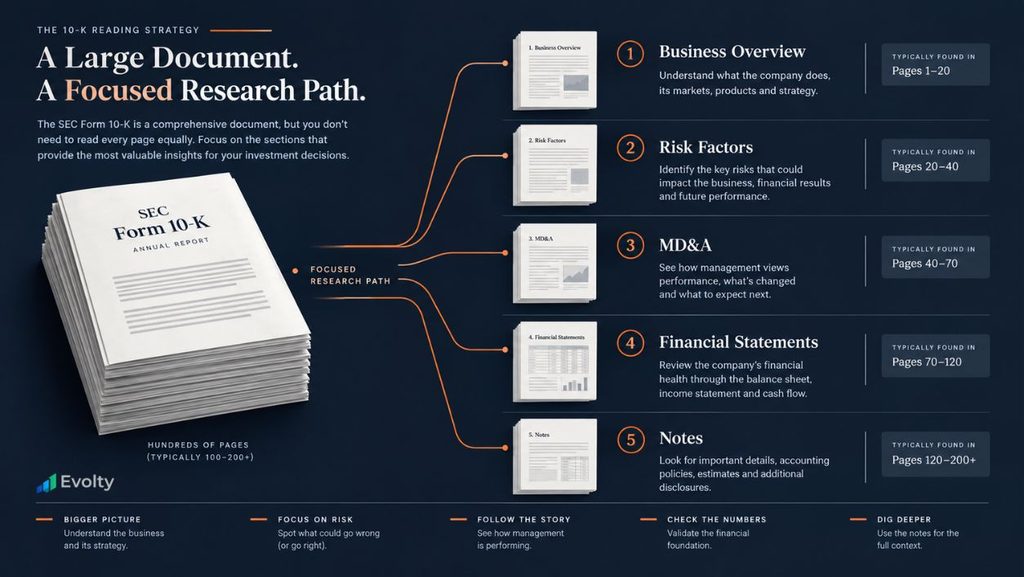
The 10-K is the annual filing that provides a comprehensive picture of a public company’s business and financial condition.
It can also be hundreds of pages long.
That doesn’t mean you need to read every page with equal attention.
A more practical approach is to focus on several areas that help answer the most important questions about the business.
1. Understand the Business
Start with the business itself.
How does the company make money?
Who are its customers?
What products or services generate revenue?
What makes customers choose the company instead of its competitors?
If you cannot explain the business model clearly after reading the company’s own description, that’s a signal to keep researching before drawing conclusions.
The goal isn’t to memorize the company’s language.
It’s to understand the economics behind it.
2. Study the Risk Factors
The Risk Factors section can be long and repetitive, but it shouldn’t automatically be dismissed as legal boilerplate.
The useful information is often in the specific risks.
Does the company depend heavily on a particular supplier?
Is a major customer responsible for a significant portion of revenue?
Does the business face regulatory exposure?
Is there significant debt?
Does the company depend on technology, intellectual property, or a particular market?
The question isn’t whether a company has risks. Every company does.
The more useful question is:
Which risks could materially change the economics of the business?
3. Read the MD&A for the “Why”
The Management’s Discussion and Analysis, or MD&A, provides management’s explanation of the company’s financial results and changes in its business.
This is where you move from:
What happened?
to:
Why did it happen?
Revenue increased. Why?
Margins declined. Why?
A particular business segment slowed down. Why?
Debt increased. Why?
Management’s explanation is useful, but it is still management’s narrative.
That means it should be tested against the financial statements and notes rather than accepted automatically.
The real value comes from comparing what management says with what the numbers show.
4. Don’t Stop at the Income Statement
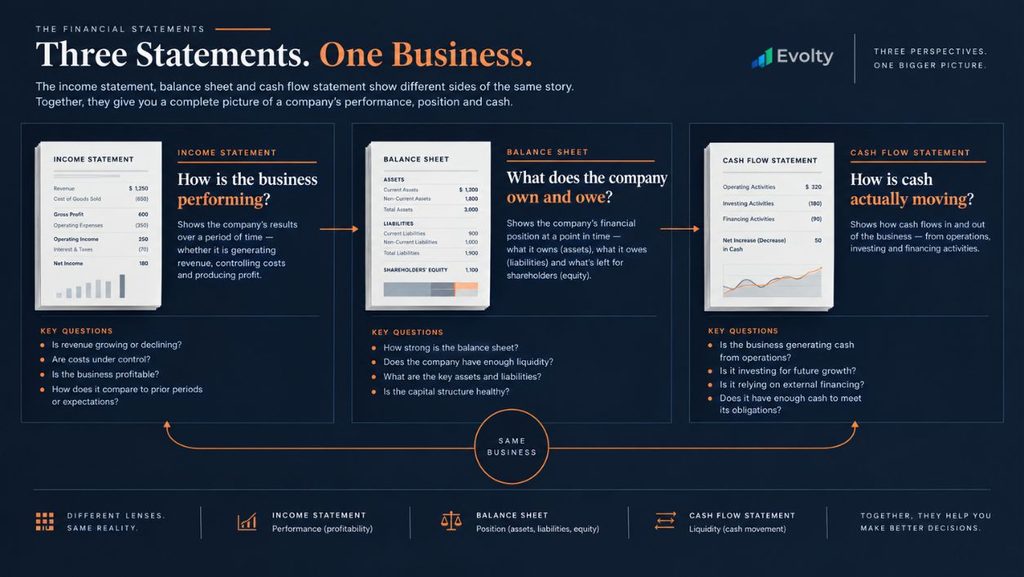
One of the easiest mistakes in fundamental analysis is focusing too heavily on revenue and earnings.
The financial statements tell different parts of the story.
Income Statement
The income statement helps you understand the company’s financial performance over a period of time.
Look at items such as:
- Revenue
- Operating income
- Net income
- Earnings per share
But don’t just ask whether revenue and earnings increased.
Ask how they increased.
Balance Sheet
The balance sheet provides a snapshot of what the company owns and owes.
Pay attention to:
- Cash
- Assets
- Liabilities
- Debt
- Shareholders’ equity
A profitable company can still face financial pressure if its balance sheet is weak.
Cash Flow Statement
Cash flow brings another dimension to the analysis.
A company can report accounting earnings while its cash position tells a different story.
This is why investors often pay close attention to cash generated by the business and, depending on the company and context, to measures such as free cash flow.
The objective isn’t to find one magical metric.
It’s to understand whether the company’s reported performance is translating into economic reality.
5. The Fine Print Matters
The notes to the financial statements are easy to overlook.
They shouldn’t be.
The notes provide important context about the accounting policies and assumptions behind the reported numbers.
For example, investors may find information about:
- Revenue recognition
- Debt
- Leases
- Stock-based compensation
- Acquisitions
- Segment reporting
- Commitments and contingencies
- Changes in accounting policies
This is where a reported number gets its context.
Before accepting a number at face value, ask:
What accounting rules, assumptions, or circumstances produced this number?
6. Use the 10-Q to Track the Business
The 10-K gives you the annual picture.
The 10-Q helps you follow what happens between annual reports.
Quarterly filings can help you identify changes in:
- Revenue growth
- Profitability
- Cash flow
- Debt
- Business segments
- Emerging risks
Because these filings cover a shorter period, they can help you identify whether the trends described in the annual report are continuing or changing.
7. Use the 8-K for Important Events
The 8-K is different.
It is generally used to report specified significant events that shareholders should know about.
These can include events such as:
- Changes in executive leadership
- Acquisitions or dispositions
- Certain major agreements
- Bankruptcy or restructuring events
- Other significant corporate developments
The value isn’t necessarily in reacting faster than everyone else.
For a long-term investor, the more important question may be:
Does this event change my understanding of the business?
A major leadership change, acquisition, regulatory development, or restructuring can alter the assumptions behind an investment thesis.
The filing gives you the information needed to investigate that change.
8. Look for the Competitive Advantage
Understanding the business and its financials is only part of the analysis.
You also need to ask what protects the company’s economics from competition.
This is often described as an economic moat.
Possible sources of competitive advantage include:
Switching costs
Customers may face significant operational, financial, or technical costs when moving to a competitor.
Network effects
A product or platform can become more valuable as more participants use it.
Brand strength
A strong brand can influence customer preference and pricing.
Cost advantages
Scale, technology, distribution, or other structural advantages can allow a company to operate at a lower cost.
Intellectual property
Patents and other proprietary assets can create barriers to competition.
The important part is not simply identifying a supposed moat.
Ask whether the company’s financial performance provides evidence that the advantage actually exists and remains durable.
From Filing to Investment Thesis
After working through the filing, bring everything together.
A useful checklist might look like this:
- How does the company make money?
- Is revenue growing, and what is driving that growth?
- Are margins and earnings improving or deteriorating?
- How strong is the balance sheet?
- How much cash is the business generating?
- What are the company’s most important risks?
- What does management say about those risks and results?
- What competitive advantages could protect the business over time?
Then comes the most important step:
Write the thesis in your own words.
If you cannot explain why you believe the business can create value over the long term, more research may be needed.
The purpose of reading filings isn’t to make you feel more sophisticated.
It’s to make your reasoning more grounded.
The Goal Isn’t to Predict the Stock Price
Reading SEC filings won’t tell you exactly where a stock will trade tomorrow.
That’s not really the point.
Fundamental research is about understanding the business behind the ticker.
Markets can react to headlines, expectations, sentiment, and countless other factors. An investor focused on the long term has a different task: determining whether the underlying business, financial position, risks, and competitive advantages support the investment thesis.
That requires judgment.
And increasingly, it also raises an interesting question.
AI can already process enormous amounts of financial information quickly. It can summarize filings, compare periods, identify changes, and surface potential signals across thousands of documents.
But faster information processing doesn’t eliminate the need for critical thinking.
It may make the ability to ask the right questions even more important.
🎙️ Listen to the Full Episode
Want to go deeper?
In Episode 5 of The Wealth Journey, we walk through the same framework in a conversational deep dive — from the 10-K and its key sections to cash flow, financial statement notes, 10-Qs, 8-Ks, and competitive advantages.
We also discuss a practical exercise: choose one company you know well, open its latest 10-K, and see whether you can explain how the business makes money, what could threaten it, how it generates cash, and what protects its competitive position.
Listen to the full episode on Spotify
In this episode, we explore:
- How to approach a 10-K without reading it cover to cover
- What to look for in Risk Factors and MD&A
- How the three financial statements fit together
- Why cash flow deserves attention alongside earnings
- What the financial statement notes can reveal
- When to use 10-Q and 8-K filings
- How to identify potential competitive advantages
- An eight-step framework for company research
- How AI could change financial analysis
Build Your Research Process With Evolty
Reading primary sources is powerful, but analyzing a company still requires time, context, and a consistent research process.
Evolty is designed to help investors explore company fundamentals, expectations, risks, catalysts, peer comparisons, and scenarios in one place — so they can spend more time asking better questions about the businesses they are researching.
Explore Evolty and build a more structured approach to your research.
Disclosure: Evolty provides educational and informational content only. Nothing in this article or podcast constitutes investment, financial, legal, tax, or professional advice. Investors should conduct their own research and consider their individual circumstances before making financial decisions.