

Why Portfolio Structure Matters More Than Stock Picking
What if finding the perfect stock isn’t nearly as important as building the right portfolio?
Investors often spend hours searching for the next great company, the next AI winner, or the stock that could transform their wealth.
But long-term investing is not just about finding winners.
It is about building a portfolio that can withstand uncertainty.
In our latest Evolty podcast episode, we explore why portfolio structure, diversification, asset allocation, and rebalancing can matter more than any individual stock pick.
🎙️ Listen to Episode 4: Why Portfolio Structure Matters More Than Stock Picking
The Problem With Finding “The Perfect Stock”
Imagine you could identify the best-performing company of the last decade.
You know its business is strong. Its earnings are growing. Its balance sheet is healthy. Its management team is excellent.
So why not put most—or all—of your money into it?
Because even an exceptional company operates in an unpredictable world.
Technology changes.
Regulations change.
Supply chains break.
Consumer behavior shifts.
Economies contract.
Entire industries can be disrupted.
A great company does not eliminate external risk.
That is why concentrating your portfolio around one company—or even one industry—can create a single point of failure.
A Great Business Can Still Face a Great Risk
Think about a restaurant with excellent food, strong margins, and great management.
Now imagine that almost every customer works at the same factory across the street.
The restaurant may be extremely well run.
But if that factory closes or moves away, the restaurant suddenly loses most of its customers.
The problem wasn’t the quality of the restaurant.
The problem was structural dependence.
A portfolio can have the same weakness.
You can own an outstanding company and still have too much exposure to the risks surrounding that company, industry, or economic theme.
Owning More Stocks Doesn’t Automatically Mean You’re Diversified
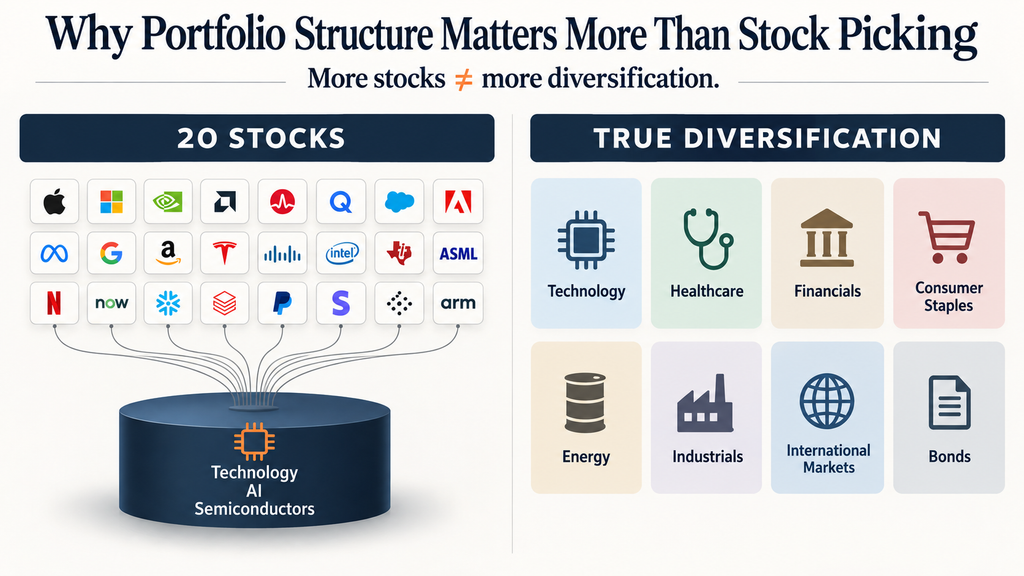
Here’s another common misconception.
Suppose you own 20 different technology and AI companies.
Twenty tickers.
Twenty different corporate logos.
It looks diversified.
But what happens if a major regulatory change affects artificial intelligence? Or a disruption hits the semiconductor supply chain?
Those companies could all be affected at the same time.
You may own 20 stocks, but you may still be making one concentrated economic bet.
True diversification isn’t simply about owning more companies.
It is about spreading exposure across different economic drivers.
That can include different:
- Sectors and industries
- Geographic markets
- Company sizes
- Asset classes
- Sources of risk
The objective isn’t to eliminate risk.
It is to avoid having one event determine the outcome of your entire portfolio.
Your Portfolio Has to Survive You, Too
There is another risk investors often underestimate:
their own behavior.
On paper, a portfolio with a very high allocation to equities may produce attractive long-term returns.
But what happens when the market drops 30% or 40%?
Would you stay invested?
Or would fear convince you to sell?
Your answer to that question may reveal more about your actual risk tolerance than a questionnaire ever could.
A portfolio should be designed around the investor who will actually hold it—not the investor they imagine themselves to be during calm markets.
A portfolio must be designed for your behavior, not your ego.
Because a strategy doesn’t help if you abandon it during the exact market conditions it was designed to survive.
Risk Changes as Your Financial Life Changes
Your investment timeline matters too.
Someone in their 30s with decades before retirement faces different financial constraints from someone who has just retired.
One important concept is sequence-of-returns risk.
The order in which market returns occur can have a significant impact when you are withdrawing money from your portfolio.
A major market decline early in retirement can be particularly damaging because you may have to sell investments after they have fallen in value to fund your living expenses.
That can reduce the capital available to participate in a future recovery.
When you are still working and contributing to your investments, you have a different set of options.
This is one reason portfolio structure often changes as investors move through different stages of their financial lives.
Three Portfolio Structures, Three Different Objectives
There is no single asset allocation that works for everyone.
To illustrate how portfolio structure can change, consider three simplified models:
| Portfolio | Equities | Bonds | Cash |
|---|---|---|---|
| Conservative | 40% | 50% | 10% |
| Balanced | 60% | 35% | 5% |
| Growth | 85% | 10% | 5% |
These are illustrative models, not recommendations.
They demonstrate the trade-off between growth potential, volatility, liquidity, and time horizon.
A growth-oriented portfolio may have greater exposure to long-term equity growth, but it can also experience larger drawdowns.
A more conservative structure may sacrifice some potential growth in exchange for greater stability and liquidity.
The important question isn’t simply:
“Which portfolio could produce the highest return?”
It is:
“Which structure fits my financial timeline, liquidity needs, and ability to remain invested?”
The Portfolio Doesn’t Stay the Same
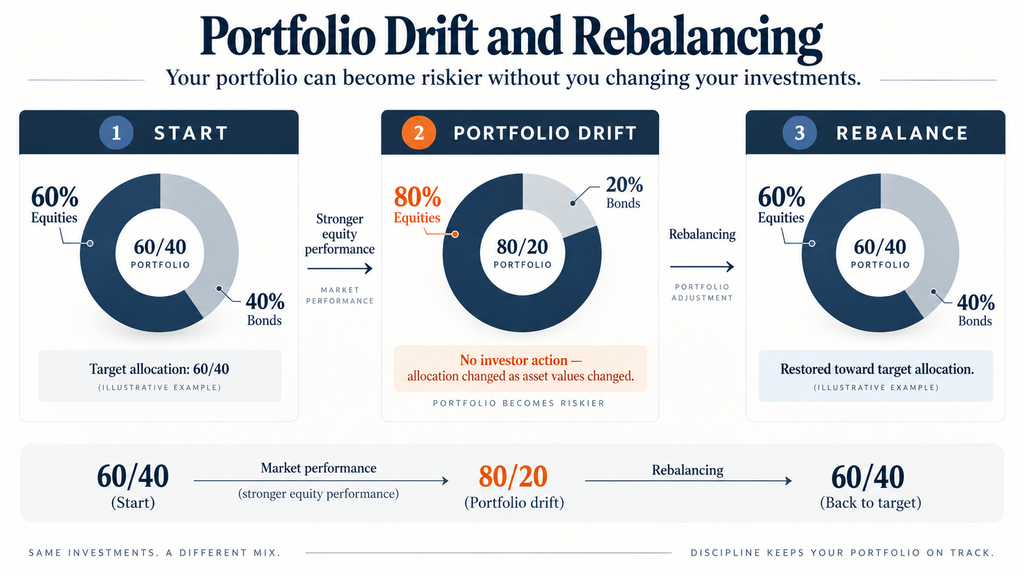
Even if you build the right portfolio today, it won’t necessarily stay that way.
Imagine starting with a portfolio that is:
60% stocks / 40% bonds
Then stocks experience years of strong growth.
Without making a single conscious decision, your portfolio could eventually become:
80% stocks / 20% bonds
Your original allocation has drifted.
And so has your risk.
You didn’t decide to become more aggressive.
The market did it for you.
Why Rebalancing Matters
This is where rebalancing comes in.
Rebalancing brings your portfolio back toward its intended allocation.
It can feel completely counterintuitive.
If stocks have performed extremely well, why sell some of them?
Because the purpose isn’t to predict the next market move.
It is to maintain the structure you originally chose.
Rebalancing can force you to trim an asset class that has grown beyond its target and redirect capital toward areas that have become a smaller part of the portfolio.
In simple terms:
Buy low. Sell high. Without trying to time the market.
It turns discipline into a process rather than an emotional decision.
The Goal Isn’t to Win Every Year
This may be one of the hardest ideas for investors to accept.
A genuinely diversified portfolio will often contain something that is underperforming.
If technology is booming while energy is flat, some parts of a diversified portfolio may look disappointing.
That’s not necessarily a flaw.
It can be the cost of diversification.
You may not capture the absolute highest return of a concentrated bet during a particular market cycle.
But the purpose of diversification is not to win every sprint.
It’s to build a portfolio that can stay standing when conditions change.
Think Like a Portfolio Architect
Individual companies matter.
But they are only one piece of the investment decision.
A resilient portfolio also requires you to think about:
How much risk can I actually tolerate?
When will I need this money?
How diversified are my economic exposures?
What happens if one sector experiences a major disruption?
How will my portfolio change if certain assets outperform for years?
And perhaps the most uncomfortable question:
Are my investing habits helping my strategy—or undermining it?
If you check your brokerage account every morning, react to every headline, and constantly change your positions, the problem may not be your stock selection.
It may be the structure around it.
🎙️ Listen to the Full Episode
Want to go deeper?
In Episode 4 of the Evolty podcast, we explore the mechanics behind portfolio construction and why experienced investors think beyond individual stock picks.
Why Portfolio Structure Matters More Than Stock Picking covers:
- Asset allocation
- True diversification
- Behavioral risk
- Sequence-of-returns risk
- Portfolio drift
- Rebalancing
- Long-term portfolio resilience
🎧 Listen to the full episode on Spotify:
Why Portfolio Structure Matters More Than Stock Picking — Spotify
Build the Foundation Before Chasing the Winner
The next time you’re researching a stock, don’t only ask:
“Could this company be a great investment?”
Ask a bigger question:
“What role would this investment play in my overall portfolio?”
Because building wealth isn’t only about finding exceptional companies.
It is also about building a financial structure that can survive uncertainty, market cycles, and your own emotions.
Don’t just pick stocks. Engineer a resilient financial foundation.
Evolty provides educational content designed to help investors research and understand companies and markets. This article and podcast are for educational purposes only and do not constitute investment, financial, or other professional advice.