
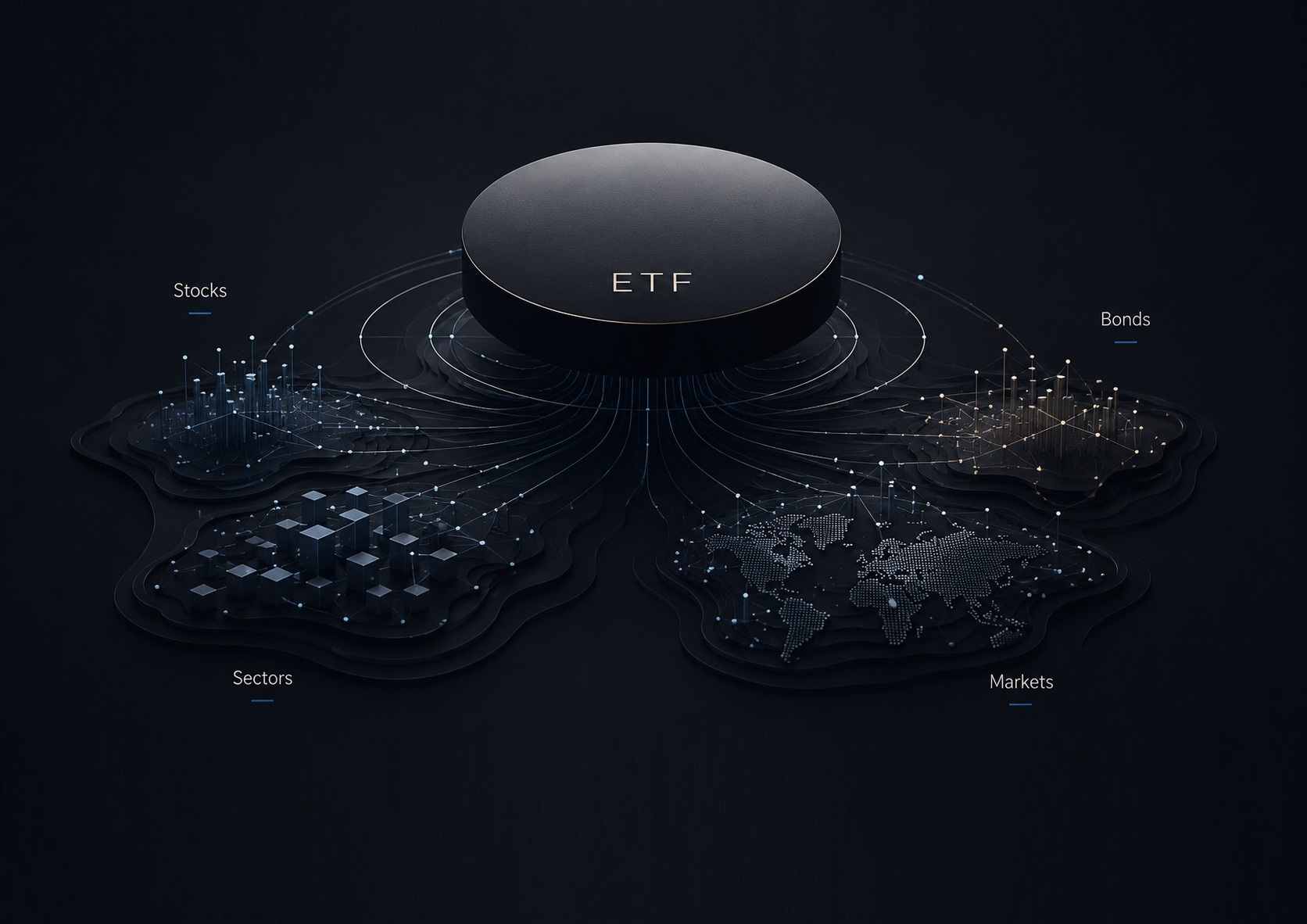
ETFs Explained: How They Work and Their Hidden Risks
ETFs have made investing easier to access than ever.
With a single purchase, an investor can gain exposure to dozens, hundreds, or even thousands of securities. They can follow an entire market, a specific sector, a group of countries, or even a particular investment theme.
That simplicity is part of what makes ETFs so attractive.
But it can also create a false sense of simplicity.
Because when you buy an ETF, you’re not really buying “an ETF.” You’re buying exposure to everything that sits underneath it — and understanding those underlying investments can tell you much more than the ticker symbol ever will.
In the first episode of The Wealth Journey, we take a closer look at how ETFs work and some of the risks that can be easy to overlook.
🎙️ Listen to the full episode on Spotify:
How ETFs Work: Hidden Risks Every Investor Should Know
What is an ETF, really?
An ETF, or exchange-traded fund, is a fund that trades on a stock exchange, just like an individual stock.
Instead of buying each investment separately, you can buy a share of an ETF that gives you exposure to a collection of assets.
Depending on the ETF, that collection could include:
- U.S. stocks
- International stocks
- Bonds
- Commodities
- Real estate securities
- Specific industries
- Investment themes
A broad-market ETF, for example, may give you exposure to a large number of companies with one investment.
A technology ETF might focus on companies in one sector.
A thematic ETF might focus on something much more specific, such as artificial intelligence, cybersecurity, or clean energy.
They are all ETFs.
But they don’t necessarily provide the same kind of diversification — or the same level of risk.
And that’s where things get interesting.
The most important question isn’t “Which ETF should I buy?”
It may be:
“What am I actually buying?”
This is one of the simplest questions an investor can ask, and one of the most useful.
Before looking at an ETF’s recent performance, take a look underneath the surface.
What companies does it hold?
How much does each company represent?
Which sectors or industries dominate the portfolio?
What index or strategy does the ETF follow?
How often does the portfolio change?
These details help explain why an ETF behaves the way it does.
A simple example
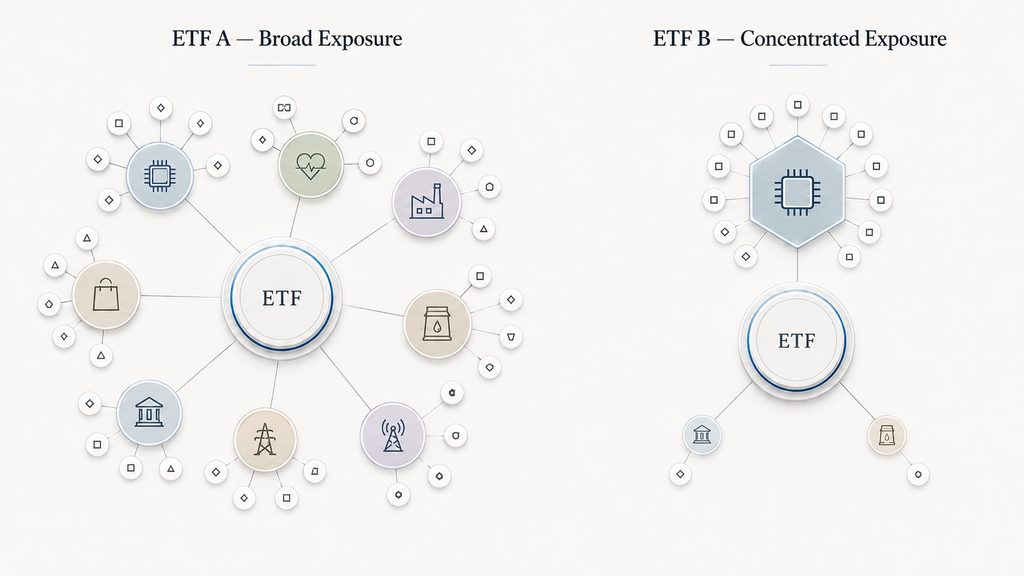
Imagine two ETFs:
ETF A holds 500 companies across many industries.
ETF B holds 50 companies, mostly from one industry.
Both are ETFs. Both may offer diversification compared with buying a single stock.
But they are not giving you the same exposure.
ETF A is designed around a broad market.
ETF B is much more dependent on what happens within one particular sector.
Neither is automatically “better.”
The important thing is knowing the difference.
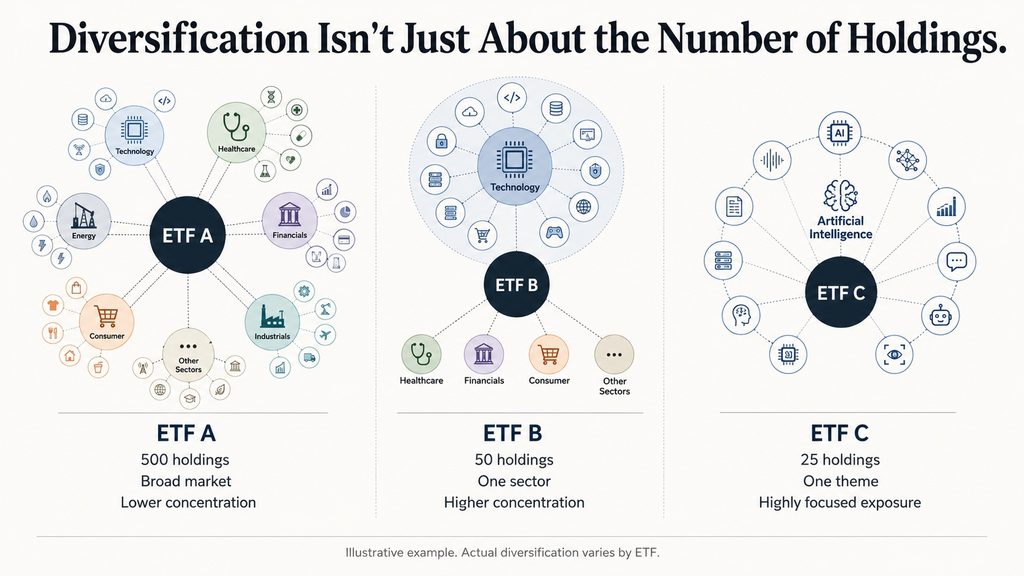
More holdings don’t always mean more diversification
This is one of the easiest ETF concepts to misunderstand.
Suppose an ETF holds 100 companies.
It sounds diversified.
But now imagine that its top 10 holdings represent a very large portion of the portfolio.
The fund may have 100 names, but a relatively small group of companies could still have a major influence on its performance.
This is why looking only at the number of holdings can be misleading.
Think about diversification this way
Broad market
Many companies
↓
Many industries
↓
Less dependence on one area of the market
Sector ETF
Fewer industries
↓
More concentrated exposure
↓
Greater dependence on one sector
Thematic ETF
A specific theme
↓
Often a narrower group of companies
↓
Potentially greater concentration and volatility
The takeaway isn’t that concentrated ETFs are bad.
It’s that concentration should be intentional.
The ETF overlap problem
Here’s another scenario that may look diversified at first.
Imagine an investor owns three ETFs:
- A broad U.S. market ETF
- A technology ETF
- An AI-focused ETF
Three different ETFs.
But what happens if several of the same large technology companies appear in all three?
The investor may have three positions but much more concentrated exposure than they realize.
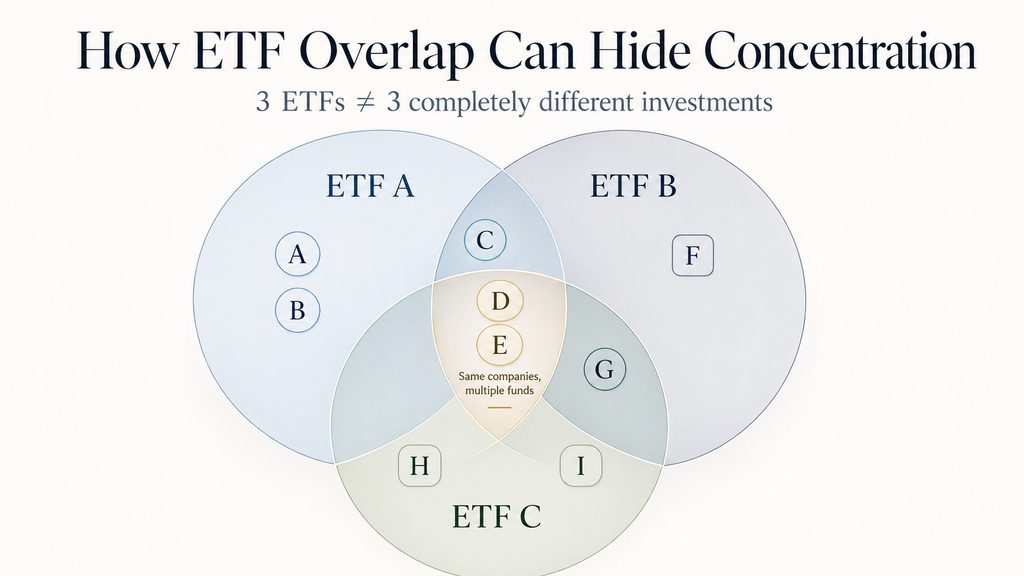
This is known as overlap.
And it’s one reason looking at the underlying holdings can be so valuable.
Here’s a simple way to visualize it
Imagine three circles:
Broad Market ETF
Technology ETF
AI ETF
In the areas where the circles overlap, some of the same companies appear.
Now imagine an investor adding a fourth ETF because they believe they’re “diversifying.”
If that fourth fund contains many of the same holdings, they may actually be increasing an existing exposure rather than creating a new one.
More ETFs don’t necessarily mean more diversification.
What about thematic ETFs?
Thematic ETFs deserve particular attention because they are easy to understand from a storytelling perspective.
Artificial intelligence.
Robotics.
Clean energy.
Cybersecurity.
Space exploration.
The themes are compelling.
But an investment theme and an investment strategy are not exactly the same thing.
A theme can grow rapidly while individual companies within that theme struggle.
And a company can benefit from a trend without being a good investment at every price.
That’s why investors should look beyond the story.
Ask:
What companies are actually inside the ETF?
How are they weighted?
How concentrated is the fund?
What assumptions are already reflected in their valuations?
The more specialized the ETF, the more important those questions become.
The risk isn’t always where you think it is
When people hear “risk,” they often think about the possibility that the market will go down.
That’s certainly part of it.
But ETF risk can come from several directions.
Market risk
If the assets held by the ETF decline, the ETF can decline too.
Diversification doesn’t eliminate market risk.
Concentration risk
A fund may be heavily exposed to a particular company, sector, country, or theme.
Overlap risk
Different ETFs can contain many of the same holdings, creating unintended concentration.
Strategy risk
Some ETFs use specialized strategies, including leveraged or inverse exposure.
These products can behave very differently from traditional ETFs and require a clear understanding of how they are designed.
Liquidity and trading considerations
ETFs trade throughout the day, but not every ETF trades with the same level of activity.
Investors should understand the trading characteristics of the fund they’re considering rather than assuming all ETFs behave the same way.
A five-minute ETF check
You don’t need to become a portfolio manager to start asking better questions.
Before buying an ETF, take a few minutes to look at five things.
1. Holdings
What does the ETF actually own?
2. Top holdings
How much of the portfolio is concentrated in its largest positions?
3. Sector exposure
Are you buying a broad market or making a much more specific bet?
4. Strategy
What index, methodology, or approach determines what the fund owns?
5. Overlap
Do you already own many of these same companies through another ETF or investment?
That last question is particularly easy to skip.
And sometimes it’s the one that changes the picture the most.
Don’t judge an ETF by its ticker
An ETF ticker can be familiar.
The name can sound appealing.
The recent performance can look impressive.
But none of those things tells the whole story.
A better way to think about an ETF is to treat it as a window into a portfolio.
Look through the window.
See what is inside.
Understand how those investments are weighted.
Then ask whether that exposure actually makes sense for what you’re trying to accomplish.
That’s a more useful starting point than simply asking whether an ETF is “good” or “bad.”
Key takeaways
- An ETF is a fund that provides exposure to a collection of investments.
- ETFs can range from broadly diversified to highly specialized.
- The number of holdings doesn’t necessarily tell you how diversified a fund really is.
- Different ETFs can have significant overlap.
- Thematic ETFs can provide focused exposure, but focused exposure can also mean greater concentration.
- Understanding an ETF’s holdings and strategy can be more informative than looking at its ticker or recent performance alone.
- More ETFs don’t automatically mean a more diversified portfolio.
Want to go deeper?
We explore the mechanics behind ETFs and the risks investors can overlook in the first episode of The Wealth Journey.
🎙️ Listen to the full episode on Spotify:
How ETFs Work: Hidden Risks Every Investor Should Know
And if you’re researching ETFs, Evolty is designed to help you look beyond the ticker and better understand what you’re actually buying.
Explore Evolty →
Evolty
Important Disclosure
This article is provided for educational and informational purposes only. It is not investment, financial, legal, or tax advice, and it does not constitute a recommendation to buy or sell any security or investment product.
Investing involves risk, including the possible loss of principal. Past performance does not guarantee future results. Investors should conduct their own research and consider their individual circumstances before making investment decisions.